


How To Cut Out Stepped Flashings For Roofs
Description
This section is from the book "Cassell's Cyclopaedia Of Mechanics", by Paul N. Hasluck. Also available from Amazon: Cassell's Cyclopaedia Of Mechanics.
How To Cut Out Stepped Flashings For Roofs
In marking off, cutting out, and fixing lead step flashings proceed as follows. The lead should be cut out 13in. wide, 6 in. of it to lie on the roof and 7in. to stand against the wall. The folding line and water line should be marked with chalk, and the lead folded at right angles on the folding line. As roofs vary in their pitch or angle of slope, and as the joints of the brickwork are not always at exactly the same distance apart, the lead, after folding, should be laid in the position it is to occupy, and, with the help of a wooden straightedge, the bottom edge of the joint in each course should be marked with a pointed piece of chalk as far as the water line, as shown at A A in the accompanying illustration. The lead should then be laid on a board on the wall side, and the lines BB marked, one end of this line being lin. from the edge of the lead, and the other end cutting the joint line on the water line. Outside the lines A A, mark those shown at C C 1 in. distant. These lines indicate the place of folding for turning into the brickwork. The folding is done with a step turner, which is an iron tool like a double-bladed chipping knife.
A temporary tool can be made out of apiece of 1 1/4-in. hardwood, with one end cut to a bevel, and having a saw-cut equal to the thickness of the lead on one edge. In the illustration, which is drawn for a roof having a slope of 45°, the shaded parts are those which are to be cut away.
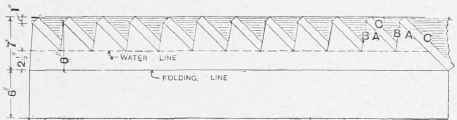
Cutting Out Stepped Flashings for Roofs.
Continue to:


My Books

