


How To Determine The Sizes Of Gauge Boxes For Compo
Description
This section is from the book "Cassell's Cyclopaedia Of Mechanics", by Paul N. Hasluck. Also available from Amazon: Cassell's Cyclopaedia Of Mechanics.
How To Determine The Sizes Of Gauge Boxes For Compo
The following instructions are for determining the areas of square gauge boxes of four different sizes. No. 1, to measure 1yd. of sand, being given as 3 ft. square and 3ft. deep; No. 2, to measure 1/2 yd. of sand or cement; No. 3, to measure 4yd. of cement; and No. 4, to measure iyd. of cement. It is supposed that all the boxes are to be of the same depth, and so it is only necessary to find the lengths of the respective sides. To do this, find the area in each case, and the square root will give the length required. The area of the first box being 9ft., the area of the 1/2-yd. box will be 4.5 ft., the area of the 1/3-yd. box will be 3 ft., and the area of the 1/4-yd. box will be 2 1/4 ft.; therefore, extracting the square root in_each case gives √4.5 = 2.14 or practically 2 ft. 1 3/4 in.; √3 = 1.7 or practically 1ft. 87/8 in.; √2.25 = 1"5, or practically 1 ft. 6in., which gives the length of the sides in each case. To determine this by geometry, let, A B C D represent the area of the larger box, drawn to scale.
Now, on the side B C construct a semicircle, and bisect B C in E, and draw E F perpendicular to B C; then joining B F gives the side of a square half the area of the square A B C D. Next divide C D into three equal parts, as shown, and on it construct a semicircle and draw H K perpendicular to C D; then joining D K and C K gives sides of squares one-third the area and two-thirds the area of the larger square. The construction of the quarter area of A B c D is similarly shown at C L.
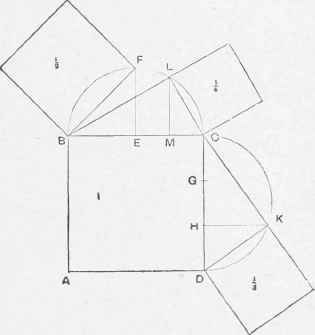
Determining the Sizes of Gauge Boxes for Compo.
Continue to:


My Books

