


How To Make Draw-Hooks
Description
This section is from the book "Cassell's Cyclopaedia Of Mechanics", by Paul N. Hasluck. Also available from Amazon: Cassell's Cyclopaedia Of Mechanics.
How To Make Draw-Hooks
Figs. 1 and 2 shows a locomotive engine drawbar hook and shackle of a pattern generally used. The method of making the shackle is explained on p. 67. The hooks are usually made of Bessemer steel, forged to shape under a steam hammer and stamped with a pair of blocks. If wrought-iron is used, the hooks are forged to the shape shown by A (Fig. 3), placed on a block E, which revolves by steam or hydraulic power, and the wheel C bends the hook to the required shape, the object being to have the grain of the iron following the bend of the hook. The " Gedges " hook shown by Figs. 4 and 5 is used as a standard railway wagon coupling by most British companies, and is undoubtedly the best form of wagon hook, but it is not generally used on engines. The pin of a pin-and-shackle coupling is apt to get bent, and the coupling is then stiffened. In the two views of a Gedges wagon hook given by Figs. 4 and 5 it will be seen that the part A (Fig. 4) is flat so as to slip in the part B (Fig. 5). This does away with the pin, and gives free working to the coupling.


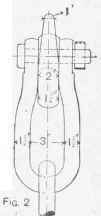


Fig. 5. Making Draw-hooks.
Continue to:


My Books

