


How To Make Insect Cases
Description
This section is from the book "Cassell's Cyclopaedia Of Mechanics", by Paul N. Hasluck. Also available from Amazon: Cassell's Cyclopaedia Of Mechanics.
How To Make Insect Cases
The construction of a case to hold butterflies, moths, etc., is very simple. Make an ordinary box of the size required, and across the middle put a partition dividing the box into two; hinge the lids as shown in Fig. 1, and fasten them with hasps, locks, or straps. Fig. 2 shows the construction of another form of case. Assuming that the insects are to be "set" in the field and pinned inside the box, the whole of the inside of the box may be covered with entomological cork, procured in sheets about I in. thick; though this would be very bad policy, as the box will hold comparatively few. Collectors always place the captives in envelopes and "set" them at home. The usual method is as follows. On catching the insect, pinch it under the wings between the finger and thumb, when it will at once be killed, and its wings will be close together, thus preventing the "view side" from being rubbed. Now take a small square of paper, and crease it as shown by the dotted lines in Fig. 3. By folding 1 over 2 and 3 over 1 a triangular envelope is formed, into which the insect is dropped; fold 4 over 3, and the insect will be in the position shown by Fig. 4. Of course, the cork is not necessary in this case.
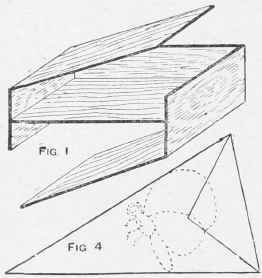
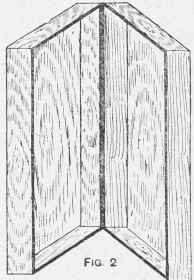
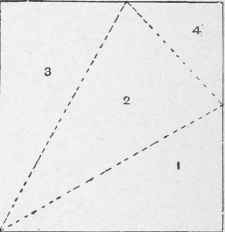
Fig. 3. Insect Cases.
Continue to:


My Books

