


How To Photograph With Telescope
Description
This section is from the book "Cassell's Cyclopaedia Of Mechanics", by Paul N. Hasluck. Also available from Amazon: Cassell's Cyclopaedia Of Mechanics.
How To Photograph With Telescope
A telescope or an opera glass may be used as a telephoto lens (that is, a lens for obtaining larger images of distant objects with less extension of camera) in the following way. Support the telescope with clamps at the necessary angle, the object-glass facing the object. A front fitting the eyepiece must he made to slide into the front grooves of the camera. For the best results it is essential that the focus of the eyepiece should be either one-half or one-fourth the focus of the object-glass, and the distance of separation must always be greater than the difference between their two foci. It may therefore be necessary to substitute a new eyepiece.
Find the principal focus of the object-glass and, supposing this to be 36in., then a concave lens of 18in.or of 9 in. should be fitted at a distance of, say, 19 in. or of 28 in. respectively, giving an equivalent focus of 648in. or of 324in. With such a lens the magnification for any given extension of the camera may be found by dividing the distance between the negative lens and the ground glass by the focus of the negative lens and adding 1; thus, 18/9 +1 = 3. The illustration shows the course of rays A through the object-glass B received by the negative lens C and widened out until they reach the plate D. Thus the magnification (that is, the number of times larger the image will be at D than at C) will depend firstly on the dispersive power of C (that is, the focus), and secondly on the extension of the camera or the distance between C and D. Unless both lenses are corrected for chromatic aberration, sharp definition must not be expected. The equivalent focus shows the focus necessary for a single lens when an image of the same size is required under similar conditions.
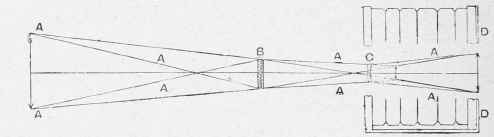
Photography with Telescope.
Continue to:


My Books

