


How To Repair Oval And Square Baskets
Description
This section is from the book "Cassell's Cyclopaedia Of Mechanics", by Paul N. Hasluck. Also available from Amazon: Cassell's Cyclopaedia Of Mechanics.
How To Repair Oval And Square Baskets
Baskets should be repaired before they are too badly worn. As soon as the foot rim gets broken, well soak that part, draw out all foot stakes (with pincers, if necessary I, and put on a new rim. If there is no foot rim, cut out the worn bottom with shears or, if the bottom part is thoroughly soaked, the workman can push it inwards with his foot. If the bottom edge of the body itself is worn, pull off a few rounds, push down a stake wherever one may have worn or broken, and work some upsetting to replace that which has been removed. A new bottom must now be made to replace the old one. Of course, the stakes in the body must he cut quite level all round at the bend after the upsetting has been finished off. Occasionally gauge the bottom to the body so as to get a good fit; then cut off the ends of the bottom sticks, and tie in the bottom with osier bands. An oval basket will require about six hands, two at each side and one at each end. A large square basket may require eight or ten bands, three at each side and two at the ends. To keep the bottom in place while tying, push two or three bodkins through the upsetting and into the bottom, down beside the bottom sticks. Next pick out and point six or eight band rods.
Push one down the upsetting in the body, and commence twisting it rope fashion from the tip end to the butt. The rod can now be drawn in and out exactly as can a piece of rope. With the bodkin, open the weavingin the bottom, about 4in. from the edge, at the right-hand side of the nearest bottom stick; pull the band through from the inside, then out again at the other side of the same stick; twist it over the 1-in. lap twice, pulling it very tight and even, then carry it for about 6in. up the side of the basket, and push it through to the lett of a stake. Bring it out to the right about 1 in. nearer the bottom, and again twist it over itself three times along the bottom twisted part; return it through the first loop, still keeping an even twist, then pass it through the edge of the bottom, and upset, again forming a close and even twist up the side; finally, pass it through the side loop, pull very tightly, and cut off the waste piece neat and close. The accompanying illustration shows part of a tying-in band. A is passed through the side of the body and comes out again at the right-hand side of the stake, and is worked the whole length again, when it is turned in the loop in the bottom (outside), and finishes as at C, outside. The even twist is obtained by pulling tightly.
When all the bands are finished, a foot rim can be worked on. Should any of the top border stakes be broken, push down others in their places, bend them down, draw them through from the front, and cram them. Some stakes will simply require pushing through the border from the front and cramming, the inside end being cut off close.
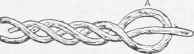
Repairing Oval and Square Baskets.
Continue to:


My Books

