


Incandescent Burner For Oil
Description
This section is from the book "Cassell's Cyclopaedia Of Mechanics", by Paul N. Hasluck. Also available from Amazon: Cassell's Cyclopaedia Of Mechanics.
Incandescent Burner For Oil
The accompanying sketch shows an ordinary central draught oil Lamp argand burner adapted for use with a mantle. It is so designed that the entire outside, including mantle and chimney, lifts off for lighting and trimming, and leaves the wick-tube standing clear. This is not absolutely essential, but it lessen- the risk of damaging the mantle. The tube A fits into the wick-tube as shown, and can be removed if a mantle is not available, and carries with it all the special fittings. Another tube I! is attached to A, contracted, and perforated at C. On the top a flange l> is fixed. Inside B a socket 1' is fixed to support the disc or "spreader" E. A cone G is attached to the removable part of the burner, from which the wire II rises to support the mantle. When the wick is lighted, and raised about halfway between the top of the wick-tube and flange D, air enters through the triangular space K (always present in a burner with a conical wick-tube). Part of the air current goes through the perforations C in B and is slowed down by so doing. It is directed against the inside surface and edge of the wick, and develops from the wick the gas of combustion.
A rapid current of air enters through perforations J, and rises between cone G and the wick-tube, and carries the flame up from the outside and outer edge of the wick, whereby a blue flame of intense heat is produced. Another current of air rises in the centre of the burner and issues laterally between flange D and spreader E. This causes a whirling or eddying motion of the air and the vapour of the oil, ensuring thorough mixture and freedom from soot and smell. It also causes the flame to rise in the form of a long cone, completely enveloping the mantle. Yet another air-current rises through the perforations L and keeps the flame away from the chimney. The air-currents are indicated by arrows without letters appended. A cone outside G, and somewhat higher, may be added, over which the end of the mantle will slip, and thus will be held steady whilst the lamp is moved about. The wick winder is not shown. Some experiment will be necessary to get the right proportions between the air-currents.
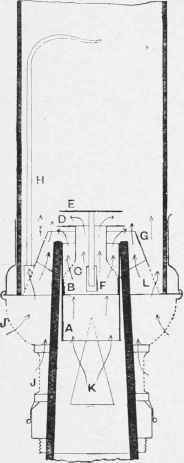
Incandescent Burner for OIL.
Continue to:


My Books

