


Roof Of Corrugated Iron And Felt
Description
This section is from the book "Cassell's Cyclopaedia Of Mechanics", by Paul N. Hasluck. Also available from Amazon: Cassell's Cyclopaedia Of Mechanics.
Roof Of Corrugated Iron And Felt
Roofing felt is usually laid on close boards, but as it is proposed to also lay corrugated iron sheets, the boarding can be dispensed with. In order to arrive at the proper distance apart of the battens, it is necessary to remember that roofing felt is usually 32 in. wide. It should be laid by commencing at the eaves at one end of the roof and laying a strip along the roof just above the eaves. The next strip higher tip should overlap 3in., and this brings the battens 2 ft. 5 in. apart from centre to centre, as shown in Fig. 1. The felt is nailed to the battens with galvanised-iron nails. If corrugated iron sheets oft. long are used and of say No. 20 or No. 2i gauge, they will reach over two batten spaces and allow of i in. overlap at the ends. The sheets are usually fastened with round-headed galvanised screws screwed through ridges, not hollows, in the sheets, as shown in Fig. 2. By this arrangement the screw is kept clear of water flowing down the sheet. Corrugated-iron ridging can be procured or a wooden ridge covering can be made. For securing the sheets at the gables, the best plan is to make wooden barge-boards, as shown in Fig. 3, with a top table projecting 3 in. or 4 in. over the edge of the sheets. To carry the gutters without fixing brackets to the walls, some simple form of iron bracket can be nailed to the sides of the rafters or principals, as shown in Fig. i.
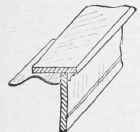
Fig. 3.

Fig. I.
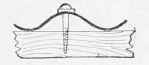
Fig. 2.
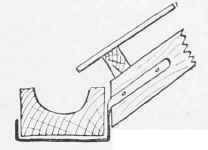
Fig. 4. Roof of Corrugated Iron and Felt.
Continue to:


My Books

