


Calculating Machines. Continued
Description
This section is from the book "The Engineer's And Mechanic's Encyclopaedia", by Luke Hebert. Also available from Amazon: Engineer's And Mechanic's Encyclopaedia.
Calculating Machines. Continued
The outer circle, marked L, has a double line of numbers; the first half circle numbered 1, 2, 3, 4, 5, 6, 7, 8, 9, and the second half marked 10, 20, 30, 40, 50, 60, 70, 80, 90. The figures on A and M may cither signify 1, 2, 3, etc, or 10, 20, SO, etc, or 100, 200, 300, etc, and as the figured divisions alter, so, of course, must the subdivisions; sometimes they stand for decimals. In passing unity to the right, the numbers will contain a figure more, and in passing to the left they will contain a figure less; the first significant figure in a decimal will vary in like manner. Two numbers in a proportion which have the same name must always be taken on the same circle. For multiplication, division, and common proportion, A must work with M; for the square root and duplicate proportion, A must work with L. In direct proportion, the first and second terms will stand together; but in indirect proportion, the second and third terms will stand together.
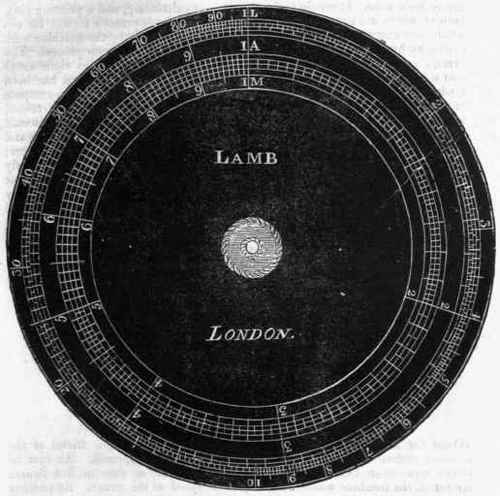
Various machines have like wise been contrived by Pascal and others, by which arithmetical calculations were made by means of trains of wheels and similar arrangements; and the late Earl Stanhope invented a machine of this sort, by which he verified his calculations respecting the national debt. Rut none of these contrivances can bear a moment's comparison with the stupendous machine designed by Mr. Babbage, and now nearly completed, the functions of which are to embody in machinery the method of differences, which has never before been done. It consists of two parts, - a calculating, and a printing part, both of which are necessary to the fulfilment of the inventor's views; for the whole advantages would be lost if the computations made by the machine were copied by human hands, and transferred to type by the common process. The greater part of the calculating machinery, of which the drawings alone cover 400 square feet of surface, is already constructed, but less progress has been made in the printing part.
The practical object of this machine is to compute and print a great variety and extent of astronomical and navigation tables, which could not otherwise be done but at an enormous expense, whilst it would be impossible to insure the same accuracy.
It can also compute the powers and products of numbers, and integrate innumerable equations of finite differences; that is, when the equation of differences is given, the engine, after being properly set, will produce in a given time any distant term which may be required, or any succession of terms commencing at a distant point. In order to convey some idea of the powers of the machine, we may mention the effects produced by a small trial engine, constructed by the inventor, and by which he computed the following table from the formula x2 + x + 41. The figures, as they were calculated by the machine, were not exhibited to the eye as in sliding rules and similar instruments, but were actually presented to it on two opposite sides of the machine, the number 383, for example, appearing in figures before the person employed in copying. The table is as follows:
41 | 131 | 383 | 797 | 1373 |
43 | 151 | 421 | 653 | 1447 |
47 | 173 | 461 | 911 | 1523 |
53 | 197 | 583 | 971 | 1601 |
61 | 223 | 547 | 1033 | 1681 |
71 | 251 | 593 | 1097 | 1763 |
83 | 281 | 641 | 1163 | 1847 |
97 | 313 | 691 | 1231 | 1933 |
113 | 347 | 743 | 1301 | 2021 |
Whilst the machine was occupied in calculating this table, a friend of the inventor undertook to write down the numbers as they appeared. At first he rather more than kept pace with the machine; but as soon as five figures appeared, the machine was at least equal in speed to the writer. At another trial, 32 numbers of the same table, containing 82 figures, were computed in 2 minutes 30 seconds, or 33 figures per minute. On a subsequent occasion it produced 44 figures per minute, and this rate of computation could be maintained for any length of time.
Continue to:


My Books

