


Geometry Problems. Part 6
Description
This section is from the book "The Engineer's And Mechanic's Encyclopaedia", by Luke Hebert. Also available from Amazon: Engineer's And Mechanic's Encyclopaedia.
Geometry Problems. Part 6
Problem XXIII
Two right lines AB, CD, being given, to find a third proportional.
Make an angle H E l, Fig. 24, at pleasure; from E make E F equal to A B, and E G equal to C D: join F G. Take EI equal to E F, and draw H l parallel to F G; then E H will be the third proportional required; that is, E F: EG:: EH: EI, or AB: CD:: CD: EI.
Problem XXIV
Three lines being given, to find a fourth proportional. Draw G H and G l, Fig. 25, making any angle H G l; take G H equal to A B, GI equal to C D, and draw H l. Make G K equal to E F; draw K L, through K, parallel to H l; then G L will be the fourth proportional required, that is GH:GI::GK:GL, or AB: CD::EF: GL.
Problem XXV
To divide a given line A B, in the same proportion as another CD, is divided.
Make any angle K H l, Fig. 26, and make H l equal to A B; then apply the several divisions of C D, from H to K, and join K l. Draw, parallel to l K, the lines e,f, g, h, i, k, l, by which the line H l will be divided as was required.
Fig. 24.

Fig. 25.

Fig. 26.

Problem XXVI
Between two given lines A B and C D, to find a mean proportional.
Draw the right line E G, Fig. 27, in which make E F equal to A B; and F G equal to C D. Bisect E G in H, and with H E or H G, as radius, describe the semicircle EI G. From F draw FI perpendicular to E G, cutting the circle in l; and l F will be the mean proportional required.
Problem XXVII
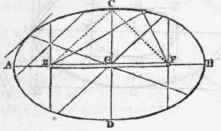
To describe an ellipsis.
If two pins be fixed at the points E and F, Fig. 28, a string being put about them, and the ends tied together at C; the point C being moved round, keeping the string stretched, will describe an ellipsis.
The points E and F, where the pins were fixed, are called the foci.
The line A B passing through the foci, is called the transverse axis.
The point G bisecting the transverse axis, is the centre of the ellipsis.
The line C D crossing this centre at right angles to the transverse axis, is the conjugate axis.
The latus rectum is a right line passing through the focus at F, at right angles to the transverse axis terminated by the curve: this is also called the parameter.
A diameter is any line passing through the centre, and terminated by the curve.
A conjugate diameter to another diameter, is a line drawn through the centre, parallel to a tangent, at the extreme of the other diameter, and terminated by the curve.
A double ordinate is a line drawn through any diameter parallel to a tangent, at the extreme of that diameter terminated by the curve.
Fig. 27.

Fig. 28.
Continue to:


My Books

