


148. Structural Steel Shapes
Description
This section is from the book "An Elementary Outline Of Mechanical Processes", by G. W. Danforth. Also available from Amazon: An elementary outline of mechanical processes.
148. Structural Steel Shapes
The use of mild steel for structural purposes, i. e., bridge building, ship building, architectural structures, railroad and other rails, etc., has developed certain standard shapes especially for these needs. The object sought in any structure built for strength is to dispose of the structural material in such a way as to get maximum strength for minimum weight of material. This does not mean that in a structure the least possible amount of material must be used, but it means that the required safe strength having been determined, the material must be so disposed that a minimum weight of material will suffice to give this strength.

I-Beam. Channel Bar.
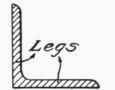
Angle Bar.
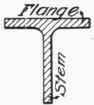
T-Bar.

Z-Bar.
Fig. 41. - Structural Shapes.
To carry out this principle, various shapes in mild steel have been standardized, but these shapes are not necessarily ideal, and are subject to improvement under experimentation. These shapes are shown in cross section in Fig. 41.
The cross-section form of each size of these shapes is standardized in area, thickness, length, slope and curvature of each part, and each running foot of length must weigh a given amount. Standard shapes of similar section are made of different weights per running foot. Special shapes are often rolled for particular uses or for a particular class of uses, and are practically standards too, inasmuch as they are extensively used.
Other shapes, for special uses are shown in Fig. 42.
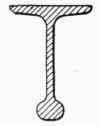
Bulb Beam. For Decks.

Railroad Rail.

* Trolley Rail.
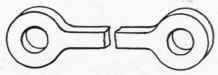
Tie Rod or Eye Bar For Bridge and Truss Work.
Fig. 42. - Special Shapes.
Large steel mills issue an elaborate hand-book giving much valuable information of sizes, dimensions, weight, strength and other particulars of steel shapes.
Continue to:


My Books

