


173. Extruded Brass
Description
This section is from the book "An Elementary Outline Of Mechanical Processes", by G. W. Danforth. Also available from Amazon: An elementary outline of mechanical processes.
173. Extruded Brass
The process of extrusion produces brass and bronze shapes similar to rolled shapes. Shapes of more complicated cross section can be produced by the extruding process than by rolling. Many brass and bronze compositions will stand cold rolling, but will not stand the extruding process.
Extruding is the process of forcing metal or other substance through a hole in a block of hard metal, usually hard steel. This block of metal is called a die and the hole in it determines the shape of the cross section of the substance forced through it.
Fig. 56 illustrates the principal features of the extruding press as used for brass and bronze. A round billet of brass is cast of such a size as will easily go in the heavy cast-steel cylinder or container A. The container may be lifted or revolved so that the billet can be placed readily in the open end at the right. The die D having been placed as shown in the view, the red-hot billet is taken from the reheating furnace, is scraped or struck to remove any clinging scale, and is quickly placed in the container which is at once lowered to the position shown. By means of intensified hydraulic pressure in the cylinder C, the ram P is forced against the billet with sufficient pressure to force the metal through the hole in the die. A man stands with tongs ready to grasp the end of the piece as it emerges through the die and conduct it along the metal-covered table T, keeping the piece straight so that it may cool straight. The lower sketch shows the front view of a die such as is used for making bronze deck-beams.
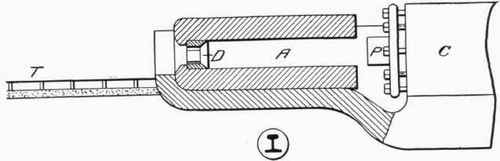
Fig. 56. - Extruding Press.
A hydraulic pressure, several times intensified, amounting to 60,000 lbs. per square inch is sometimes needed for this work. The weight of billets, limited by the capacity of the container, does not exceed 175 lbs. The quality of the extruded bars is said to be better than that of bars produced by rolling, and certainty the pressure leaves no blow holes and crowds the molecules of the metal closely together. The extruding of metals, hot or cold, is a matter of the power of the extruding press and of the ductility of the metal.
Continue to:


My Books

