


272. Defects In Castings
Description
This section is from the book "An Elementary Outline Of Mechanical Processes", by G. W. Danforth. Also available from Amazon: An elementary outline of mechanical processes.
272. Defects In Castings
The following defects and their causes are well known to foundry men:
(1) Surface and interior cavities are caused by too little metal, or by runners and risers too small to remain liquid and feed the casting until it has "set" throughout its mass.
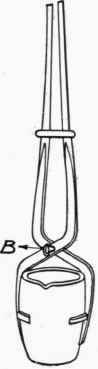
Fig. 135.
(2) Cold shuts are caused by chilled metal. When poured, sluggish metal becomes so chilled that it does not unite when it meets from opposite sides of the mould.
(3) Blow holes are caused by air, gas, or steam under the surface of the casting when it solidifies. Blow holes are from air entrained in a partially filled runner, from air entrapped in the mould space and from steam forced into the mould from the sand due to improper venting and drying. If a metal is very fluid when poured, air and gases will rise to the surface and escape. The metal itself contains little or no gas before pouring.
(4) Sand holes and cuts are formed by loose sand in the mould. Sand from the mould surfaces may come off in patches known as "scabs" due to poor venting. If the patch of sand breaks up, it forms sand holes, but if it remains intact, metal encloses it and forms a cut. Sand will float if the metal is sufficiently fluid.
(5) Shrinkage cracks are caused by a mould or core too rigid to allow a casting to shrink without cracking.
(6) Strains and warps are caused by uneven cooling. A strain is not visible, but may cause the casting to crack if hammered. A warp distorts the shape of the casting.
(7) Sponginess is caused by impurities in the metal when poured. It generally shows in brass or bronze castings when tested under hydrostatic pressure and is caused by porous oxidized metal in the casting. The defect is revealed by a sweating of the casting under high pressure. Globules of water seep through more or less rapidly and trickle from the surface.
(8) Castings may be of poor material, too hard for machining, or defective in strength. These defects are avoided by an analysis of the material before casting.
Continue to:


My Books

