


An Electric Shocking Machine
Description
This section is from the book "Amateur Work Magazine Vol1". Also available from Amazon: Amateur Work.
An Electric Shocking Machine
William Slyke.
A strong "shocking machine " can be made from an ordinary electric bell in the following manner: Remove the gong from a good size electric bell and then screw the rest of the bell to a hardwood base of sufficient size to give a margin of 1" on one side. Two holes are then bored in this margin, for receiving two binding-posts with screw base. To the arm from which the gong was removed screw a piece of fine magnet wire, twisting the other end to the screw of the nearest binding-post. One end of a similar piece of wire is twisted around the screw of the vibrator at A, Fig. 1, and the other end is twisted to the screw of the remaining binding-post, both of which can now be screwed down.
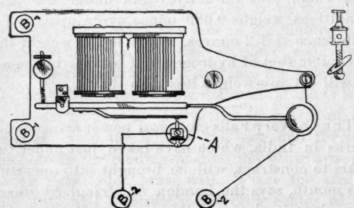
Fig. 1.
For the electrodes, two pieces of brass tubing about 31/2" long will be required. Make two wooden plugs to fit tightly in the end of each tube, boring a hole through the center of each plug large enough to receive pieces of flexible covered wire, each about 3' long. Cut the covering from each end of the wire for about an inch. Push one end through the hole in one of the plugs, turn it back over and around the sides of the plug and carefully push the plug into one of the tubes, as shown in Fig. 2. The bare wire is thus in good contact with the tube. The othei tube is prepared in the same way. The other ends of the wire are inserted in the holes in the binding-posts, using care not to force the screw toe hard and so twist off the ends of the wire. With this arrangement the electrodes can easily be removed when not in use.
A battery of two or three dry cells in series is then connected by insulated copper wire to the binding-posts of the bell frame. Upon taking the electrodes, one in each hand, a powerful shock will be felt. A small one-point switch on one of
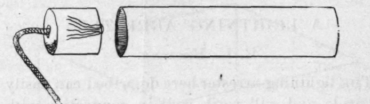
Fig. 2.
the battery wires will be found convenient to throw the battery out of circuit when not in use, and so avoid running it down, or one wire may be disconnected.
A regulator for changing the strength of the current may easily be made.
Procure a piece of glass tubing about 3" long, with fairly thick walls, also two corks which will fit tightly in the ends of the tube. Two pieces of straight copper wire, one 11/2" long and the other 21/2" long, are each twisted on one end into loops.
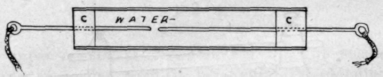
Fig. 3.
Holes are punched in the centers of the corks to receive the wires, which should fit tightly. (See Fig. 3.) Put one of the corks into the tube, fill the tube nearly full of pure water and put in the other cork. Seal each end with sealing-wax, using care not to get any on the wire. Connect the regulator by soldering to one of the battery wires, and fasten to the base by strips of brass or leather. The regulation is secured by changing the position of the longer wire ; the nearer the ends of the wire in the tube, the stronger the current. By increasing the space the current is reduced. The writer has a machine made in the way here described, which, with a battery of three cells, gives a current almost impossible to hold.
Continue to:


My Books

