


Studies In Electricity. I. Continued
Description
This section is from the book "Amateur Work Magazine Vol1". Also available from Amazon: Amateur Work.
Studies In Electricity. I. Continued
It is also true that the rapid flow of water in the system will generate a certain amount of heat, owing to the friction between the water and the pipe, and they would become warm to an extent depending on the rate of flow and friction in the pipes. Now compare this diagram with Fig. 2, and the similarity will be apparent. A represents any source of electricity, such as a battery or dynamo, B and B' conducting wires, connecting the dynamo with the electric motor C. If the dynamo be operated and the connection is complete, as shown, the current of electricity will flow in the direction indicated by the arrows, and the electric motor C will revolve and do mechanical power in precisely the same manner as the water motor in Fig. 1. The wires B and B', and other parts of the system, will also become heated, the amount of heat depending upon the rate at which the current flows through the circuit and the resistance offered to the current by the wires. If the electrical pressure could be raised sufficiently high, the electricity would escape from the wires at the weakest point of the system, and a general display of fireworks with destructive effects would be noticed, thus corresponding to the bursting of water-pipes under heavy pressure in Fig. 1. The water pressure in the latter case was stated to be 10 lbs. to the square inch. In the circuit shown in Fig. 2 the electrical pressure is given as 10 volts, as electricity has no weight and is not a material substance. It is evident that we cannot use the term pounds in connection with the pressure produced by the dynamo.
The volt is the unit of electrical pressure, and derives its name from one of the early investigators, Volta. The manner in which this unit of pressure is determined will be explained in future papers. At the present time it may be stated that a cell of gravity battery using copper, zinc and a solution of sulphate of copper, delivers a pressure of very nearly one volt per cell, regardless of its size. This battery is a familiar sight in telegraph offices, and it is used almost exclusively for this service. The pressure given by the familiar bell battery used for operating doorbells, annunciators, and consisting of a carbon and zinc cylinder in a solution of sal ammoniac, delivers a pressure of very nearly 11/2 volts, while other batteries, to be described, will produce a pressure of 2 to 21/2| volts per cell. A number of cells may be connected up in such a way as to add the pressures, and thus any desired voltage may be obtained. The current produced by batteries of this sort is continuous ; that is to say, the current continually flows through the wires in one direction, as shown by the arrows in Fig. 2. The greatest electrical pressure known is exhibited in a flash of lightning. In this case it may be so high as to force its way through a mile or more of air, and the electrical pressure, many millions of volts.
To express the quantity or amount of electricity flowing in a circuit, the term ampere, also derived from a well-known scientist, Ampere, is used. In Fig. 1 we stated that a water pressure of 10 lbs. was produced by the pump A. This statement, however, does not give us any idea as to the amount of water flowing in the" pipes at any given time; and if we wish to know this point, we should expect to be told that the rate of flow, or the amount of water passing through the pipes or through the water motor C, would be so many gallons per minute. The latter expression, of course, indicating the rate of flow. This is precisely what the term ampere indicates in an electrical circuit, and the derivation and the method of obtaining the standard is reserved for a future writing.
Once more referring to Fig. 1, we stated that the pipes and apparatus would become heated by the water passing through them under the pressure produced by the pump C, and we should state that this heating was due to the friction or resistance to the flow offered by the pipes. In an electric circuit, as illustrated in Fig. 2, the term resistance is used instead of friction. The unit of resistance, named for another investigator, Ohm, is called the ohm (pronounced like home without the h) ; and without at present going more deeply into the subject, it may be stated that an ohm is the amount of resistance offered by a wire or any other substance that will allow a current of one ampere, at a pressure of one volt, to pass through it.
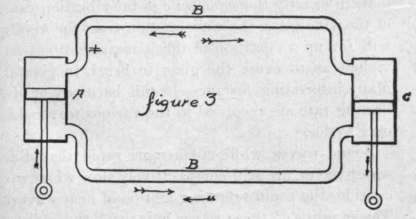
Many of our readers have no doubt heard of the alternating current, in connection with light and power systems. We have already stated that a direct current is one that is flowing continually in one direction, around and through the circuit. An alternating current, as its name indicates, is a current of electricity that flows through a circuit, first in one direction and then in the other. This is well illustrated in Fig. 3, which shows two pumps of the ordinary or piston type, connected together and filled with water on both sides of "the piston and in both pipes. It is evident that if the piston in figure A is pushed in and out, the piston in B will follow the motion of C exactly, or will be alternately pushed in and out by the action of the pump A, and the strokes of the piston in pump or motor C may be used to deliver power.
If the pump A was operated so as to deliver a pressure or thrust of 10 lbs., first in one direction and then in the other, we should have the same amount of power delivered to the pump or motor C, as in the case of Fig. 2. This illustration represents very clearly the action taking place in an electrical.circuit supplied by a generator of electricity, delivering an alternating current. In practice, a dynamo of special construction is used, which delivers a current first in one direction, then in the other, at a very high rate; the number of alternations in many cases being as high as 16,000 per minute, or 266 per second. If electric lights were operated by a slowly varying current of a few hundred alternations per minute, the lights would flicker so perceptibly as to be useless.
The alternating current has peculiar properties not possessed by the direct current, and which renders it unfit for many applications in electrical industry. It is, however, largely used for lighting, and for the transmission of power in large amounts. Direct currents are almost universally used for the operation of motors, street railway systems, electroplating, telegraph, telephone, and many other applications. The student should bear in mind that a current of electricity, whether it be derived from a battery or a dynamo, is the same, and will produce equal results in any given case. For instance, if a system of electric bells has been operated by say 10 cells of battery producing a pressure of 15 volts, the system will work equally well if a dynamo is substituted for the battery, provided the dynamo is wound and operated so as to produce the same pressure, 15 volts, and has a current capacity equal to or greater than the battery itself displays. The principle on which all dynamos operate, known as magnetic induction, opens up an entirely new field of investigation, and must be deferred for future study.
We will in the next chapter take up the practical construction of an experimental battery and apparatus for demonstrating clearly the principles and laws of electrical action just described. (To be continued.)
Continue to:


My Books

