


The Telescope. Refractor and Reflector. Part 2
Description
This section is from the book "Amateur Work Magazine Vol1". Also available from Amazon: Amateur Work.
The Telescope. Refractor and Reflector. Part 2
The form of telescope devised by Newton, and ever since known by his name, is that now commonly used for reflectors, and is shown in the diagram below.

Fig. 4.
Where a is the large mirror, or speculum, as it is generally called, b the diagonal mirror, now usually referred to as the flat, and c the eye-piece, the course of the rays is shown by the arrows; the same remark applies to the other diagrams of reflectors.
The mirrors were made of speculum metal, an alloy of copper and tin, very white, hard, and brittle, and of high reflective qualities, taking a very perfect polish.
Gregory and Cassegrain invented forms in which one looked apparently directly through the tube, as in the refractor; this, however, was only apparent, and was accomplished by placing a small speculum, concave in Gregory's form (Fig. 5), and convex in Cassegrain's
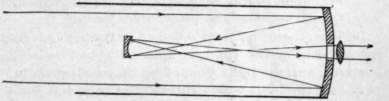
Fig. 5.
(Fig. 6). near the focus o of the great speculum, so that the rays were reflected directly back through a hole in
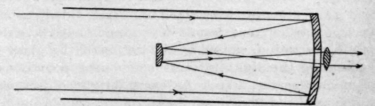
Fig. 6.
the center of the latter, to the eye-piece. These were powerful for their size, and handy to use, but were expensive, and were finally crowded out by the improved refractors of the next century.
The reflector has certain advantages over the refractor; there being but one large surface to be worked, instead of four, a perfect performance can be obtained at mucb less, expense. All the rays can be brought accurately to the same point, as is not the case in the refractor, as will be shown farther on. The image at the focus of the speculum is absolutely free from extraneous color, being formed by reflection.
In point of convenience the reflector has one very great advantage, that the eye-piece is situated, not in the prolongation of the main tube, but at right angles with it, so that the observer, instead of having to hold his head in constrained and uncomfortable positions when viewing objects at high altitudes, can always, by rotating the tube in the cradle with which it is generally provided, keep the eye-piece in such a position that he can look into it as he would into a microscope, at the angle that best suits his convenience. Any one who has had to make careful estimates of magnitude, or to try to make out delicate planetary detail with a refractor, at an altitude within a few degrees of the zenith, or even to observe at those intermediate elevations where the eye-piece is just too low to get at comfortably when standing, and just too high to be reached without stretching up from any available seat, will understand how great and substantial an advantage this is.
When you add to this that about double the power can be had at the same cost, it will be seen that there are real advantages to be urged by the advocates of the reflector.
For fifty years the reflector remained the best telescope to be had. But the difficulty of obtaining suitable metal for the speculator many years hindered its progress; besides that, the processes for producing the best figure seem for a long time to have been kept secret in a few hands, so that they were very expensive instruments, and their size and power were limited.
Besides, the metal used reflected only about seventy-five per cent of the light, so that with two reflecting surfaces, and the light stopped by the small speculum, only half the light which entered the tube was finally available for purposes of vision, while the refractor utilized about ninety per cent of the light.
The refractor, however, was limited by the spherical aberration of the lenses of which it was made, that is, the impossibility of bringing all the rays to a single point by means of lenses made on spherical curves, and many attempts were made to obviate this by modifying these curves; but it was found that the chromatic aberration, caused by the action of the glass in separating the light into its component colors, was a much greater defect, as every bright object was bordered by a fringe of these colors, increasing rapidly with the increase of aperture and convexity of the lenses.
In 1729 Mr. Chester More Hall, of More Hall near Harlow, in Essex, England, succeeded in accomplishing the desired result, and is said to have made several telescopes. But he did not make his discovery public, and the matter went no farther.
In 1747 Euler tried a lens compounded of glass and water, "but," says Chambers, "it was a signal failure."
In 1758 Dollond invented the combination of flint and crown glass now in use, for which he received the Copley Medal from the Royal Society.
The rationale of Dollond's invention is as follows: If two similar glass prisms are placed in the path of a beam of light, with their refracting angles in opposite directions, the rays of light, which are separated into their primary colors by the first prism, in virtue of its dispersive power, and bent aside by its refractive power, will be refracted to the same extent in the opposite direction by the second prism, so that the beam will issue from it with its direction unchanged, and still white, the action of the first prism having been exactly reversed by the second.
Now a lens is similar in its action to a prism, the only difference being that its surfaces are curved instead of straight; so that if we have a convex and concave lens of similar glass and equal curvatures, the beam of light will, in passing through both, be bent out of its path and dispersed, as the separation of the colors is called, to precisely the same extent by both lenses, but in opposite directions, so that it emerges unchanged.
Continue to:


My Books

