


A Model Turbine Engine. Part 3
Description
This section is from the book "Amateur Work Magazine Vol3". Also available from Amazon: Amateur Work.
A Model Turbine Engine. Part 3
The bearing sleeve is clearly shown in Fig. 12, and a cross section of same is seen in Fig. 10. For this purpose a piece of brass rod can be used. Two pieces are to be made, one for each bearing. In addition to the length required for the bearing, the pieces should be cut out of sufficient length to hold in the chuck. When the extra length is gripped in the chuck jaws, centre the end of the revolving piece with a sharp pointed tool and start a smaller drill than the size of hole required; after which the hole is trued up with a very small boring tool held in the slide rest and finished with a reamer. Next turn down the outside to i" and square up the shoulder of the outer end. The bearing is held in place by the two small adjusting screws as shown in Figs. 10 and 12. The groove for the oil ring can be cut with a file or hack saw, and the reamer must be again inserted to remove the burr. The oil ring can be made from a piece of tubing.
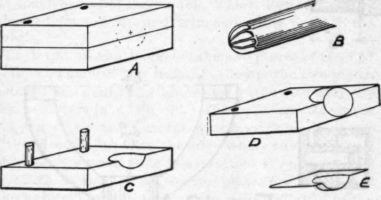
Fig. 19.
The next important operation on this head is to drill and ream the steam nozzle in the lug cast on the outer surface. The line of the centre of this nozzle should be at an angle of 20° with the inner surface of the head, as shown in Figs. 13 and 14. Fig. 13 is a horizontal section cut through the centre of the lug. This shows the manner in which the hole is drilled. The position of the hole is laid out on the inside of the head as shown in Fig. 10. It should be on a direct vertical line with, and 1 5-16" above the centre of the head. Mark the point with a centre punch. When this has been done a small piece of metal, shown in Fig. 14, should be soldered on just outside. This is to prevent the drill from running off to one side when it is started. A center punch mark should be made on the outer end of the lug at the proper point to bring the finished hole at the proper angle with the turbine wheel. Against this centre punch mark, the point of the back centre of the lathe is placed and the hole drilled. When drilling the hole the head must be carefully held up or its weight will break the drill. Use a No. 60 twist drill. The hole is next reamed out carefully with a taper reamer from the inside of the head. The hole should be 1-16" in diameter at that portion where it emerges into the casing. The outer end can be counterbored from the outside to fit the steam pipe, and the entrance to the nozzle from the pipe beveled off as shown.
The other head requires less work. All the turning can be done at one setting of che casting in the chuck. The projection of the stuffing box on the inside of the head is to be used as a chuck piece. This is firmly grasped in the jaws of the chuck. The outer diameter of the head is first turned down to the same size as the opposite head. The inside flange is next turned down to the same diameter as the inside of the 3 1/2" tubing. This can be done by using a bent tool in the tool post of the slide rest. It can be gauged for size by using a pair of calipers and setting them to fit the finishing diameter of the flange of the other head. The gauge-ing of the piece of work by the caliper must be done while it stands at rest, for if done when the work is revolving the tendency will be to leave the flange too large, as the calipers pass over a revolving piece of work with greater ease than if stationary.
The outside surface of the head is next turned off true and the recess for the gland bored out to the proper size. The small hole for the shaft should next be put through and this should done very carefully, as this will aid materially in the final lining up of the parts when the model is assembled, as will be described later. The hole should be first drilled with a smaller drill than the finished size called for, after which a small boring tool is used to true up the hole and fit it to the exact diameter of the shaft of the turbine wheel. The reason for doing this is that when the outboard bearing of the shaft is completed and ready for attaching to the casing, the wheel and shaft can be inserted, and this hole in the stuffing box will hold the shaft in alignment until the bearing can be set into place and the position of the holes for the screws marked on the head. When the outboard bearing has been fitted, the hole in the stuffing box should be enlarged a little so that the shaft will not touch it.
The packing gland is shown in Fig. 17 and will not require an extended explanation. It should be a sliding fit in the stuffing box and the hole should be at least 1-32" larger than the diameter of the shaft. Two clearance holes for No. 2-56 screws should be drilled in the flange and tapping holes to correspond marked off and drilled in the head. No finishing is required on the inside of this head.
The two heads can now be marked off and drilled for the screws which are to hold the casing together. Lay off six points around the edge of the flange of the head first described, Fig. 10, and mark them with a center punch. Drill these holes through, using a No. 42 twist drill. When all six holes are drilled place the flanges of the two heads together and hold them in position with a clamp. The projection of the stuffing box on one head will enter the oil reservoirs turned in the other head. With the heads securely held together use one of the holes as a guide for the drill and start a hole in the other head. This must not go deeper than the bevel of the lip of the drill. Mark the other five holes in the head in the same manner, after which the two heads can be separated. The holes marked should be drilled through with a No. 33 twist drill this being a clearance hole for a No. 4 screw. The holes drilled with the No. 42 drill are next tapped with a No. 4-36 tap.
After these holes are drilled the washer shown in Fig. 11 can be soldered in to place to form the oil reservoir in the head Fig. 10. The casings can then be assembled with the wheel and shaft in place.
The outboard bearing should be held in the jaws of the chuck by the outer end of the hub so that the feet project toward the slide rest. Rotate the lathe head by hand and measure with a tool in the rest to see that the piece is chucked so that the feet project equally. With a centering tool in the slide rest mark a center in the revolving hub of the casting, and using the same size drill as used for the hole in Fig. 10 put a hole entirely through to size it for one of the bearings shown in Fig. 12. The details of the parts are shown in Fig. 16.
The oil reservoir is next bored out and the little depression made for the washer. The washer, like the corresponding one in the other bearing, must not be soldered into place until the oil ring has been placed inside. The bottom of the feet must be faced off while the casting is in the chuck, lights cuts with a pointed tool being made so not to loosen work. The piece can then be removed from the chuck and the bearing sleeve fitted. The holes for two adjusting screws are next drilled and tapped, after which the clearance holes for the screws are placed in the feet. The bearing can now be slipped onto the end of the shaft projecting from the assembled casing and the position of the screw holes transferred to the casing.
The head, Fig. 15, must now be removed and the holes drilled and tapped. The hole in the back of the stuffing box can be enlarged, as mentioned, and the head replaced. The worm wheel should next be placed on the shaft in the position shown in Fig. 6 and secured by a very small set screw drilled and tapped into one end of the worm.
The bearing for the driving shaft, Fig. 18, is best finished by centering at both ends and drilling the the hole when the casting is held against the back center of the lathe. The drill used should be a trifle smaller than 1-4". Be careful that the drill does not touch the end of the back center. When the hole is nearly through, a piece of hard wood or metal should be interposed to prevent injury to the drill or center. The hole can then be reamed with a 1-4" reamer, after which it can be placed on a 1-4" mandrel and the ends squared up. If desired, the outside of the bearing can be turned down and finished on either end. If finish is desired over that portion where the flange is attached it will be necessary to do this with a file as it cannot be turned. The back of the flange should be filed up flat and parallel to the hole for the shaft, after which two screw holes are drilled.
The gear wheel and shaft are fastened together by a pin or screw and placed in position in the bearing. These parts are then held in place on the casing until the position of the screw holes are located. The points of the teeth of the gear should not be allowed to " bottom" on the worm, yet they should have sufficient contact.
If desired, a small sheet metal oil pan can be formed to fit under the gear wheel for lubrication and a cover could be made to enclose all the gearing, but there are so many who prefer to "see the wheels go'round" that these parts have not been shown. No driving wheel is shown on the end of the driving shaft. This must be made of the proper size to give the required speed to whatever model or piece of apparatus it is required to drive.
When the final adjustment of the parts is made the turbine wheel should run just as close as possible to the head containing the nozzle, but without touching it. Perhaps the easier way to make this adjustment is to loosen the screws in the bearing sleeve of the "Steam" side and screw up the adjusting screws in the outboard bearing until the turbine wheel rubs against the side of the casing when the shaft is revolved by hand. Then turn these screws back a half revolution and carefully tighten up the screws on the "steam" side until the bearing sleeve comes againtthe shoulder of the shaft. Be careful that the sleeves are not forced up too tight, as it is preferable to have a little play endwise on the shaft though this should not exceed 1-32". A stop cock should be placed on the steam pipe as near the model as convenient.
Continue to:


My Books

