


A Spectroscope
Description
This section is from the book "Amateur Work Magazine Vol3". Also available from Amazon: Amateur Work.
A Spectroscope
A. Roth Well.
The high price of many of the required instruments prevents amateurs and students from purchasing them, and entering into the study of the natural sciences, much valuable knowledge and many a pleasant entertainment is lost to those who would, but for the above reason, gladly per-sue scientific studies. The spectroscope affords a means of examining the rays of light emitted from any source and determining their composition. Those who have not seen the beautiful prismatic band from white light will marvel at its beauty and purity of color, ranging from the red to the violet. It will well repay such to make the simple and inexpensive spectroscope here described.
Procure- a piece of zinc, 14 or 16 guage, 12" long and 3" wide. Cut this into pieces to make a prism as shown in Fig. 1 ; that is, cut three pieces 3" x 2 1/2". In two of these cut out a space in the centre 1 3/4" x 3/4" as shown in Fig. 1. Solder the pieces together so that the base will form a true equilateral triangle, using a triangular piece of wood to assist in obtaining the correct shape. Then fit in the top and bottom triangular pieces, the top having a hole bored through and over this a threaded 1/2" nut is soldered. Fig. 1 shows the appearance of finished prism. Black the inside with thin glue to which a little lamp black has been added"; this is to prevent reflections.
Take a piece of sandpaper upon a flat surface, and rub the sides of the prism containing the openings until they are flat, then rough up with the corner of a file, this is to give the glue a better opportunity to stick. Take two pieces of flat glass, 16 ounce English or German plate, free from scratches, and glue on the sides containing the openings. These pieces of glass should be 3/16" smaller all around than the sides of the prism. See that sufficient glue is put on to make a thorough contact, using care to keep the centre clean and free from glue. A little glycerine or molasses may be added to the glue to keep it from drying too brittle. Set away to dry, which will take about a week. When thoroughly dry, fill the inside of the prism nearly full with a solution of bisulphide of carbon, leaving an air space for expansion. Put in a machine screw, which has been covered with glue ; allow it to set. As bisulphite of carbon has a very disagreeable odor and is very imflamable, the filling of the prism should be done in the open air and away from any flame.
This being done, take two mailing tubes from 1" to 1 \" diameter according to diameter of lenses used, but of the size to telescope, one into the other. If they do not fit snugly, paper may be wound around the outside of the smaller one until it slides easily, yet must remain stationary where placed. The next requirement will be the end of the tube that carries the slot, as shown in Figs. 2 and 3 ; the former being a section on line a a in Fig. 3 which is a front view. A circular piece of wood 1/4" thick, with a hole cut through 5/8" high and 3/8" wide, is then glued inside the inner tube so as to be at right angles to the tube. Any cutting of the mailing tubes may be done with a fine jeweller's saw in a square mitre box. The ends can be smoothed with sandpaper, the tube being held in a vertical position. The other arrangement is made out of cigar box; Fig. 4, 5, and 6 shows the arrangement to better advantage
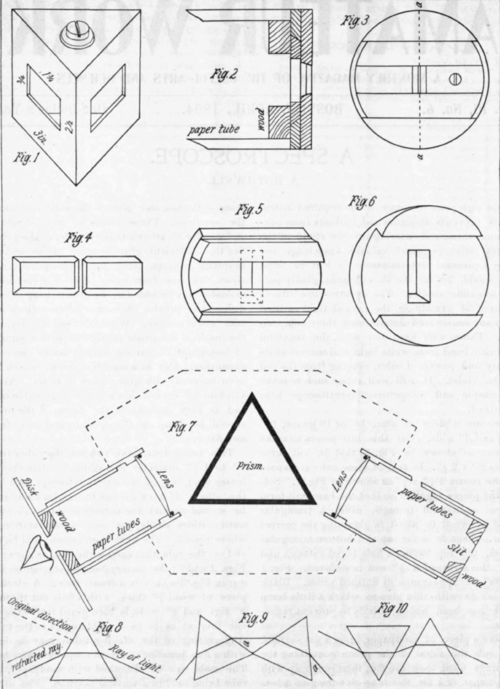
Fig. 4, being the slit goes into Fig. 5, and Fig. 5 into Fig. 6. Fig. 5, is made movable when desirable; either end of the spectrum may be brought into the centre of vision without disturbing the slit when once adjusted.
The slit proper, Fig. 4, should be made of brass or any other metal capable of receiving a high polish, the higher the polish the finer the result. The vertical joint should be perfect. One side of the slit should be made fast with a screw as shown in Fig. 3. Fig. 7 shows the arrangement of prism, lens and tubes. The lenses are held in position by gluing on the inside a piece of the mailing tube and using a piece of spring brass wire bent around the inner side of tube and pressed firmly against the lens. The eye tube is drawn about half scale, the collimator tube is shown broken, the length being determined by the focal length of lens used. The disk on eye tube is to shield the eye from outside light.
Having completed the necessary parts it now remains to place them in position, which can be done in a systematic manner avoiding all guess work. Take a flat board, on this draw two lines to equal 130°, providing the prism has been made equilateral. Let these lines represent the centre of the tubes, also of prism, on the horizontal or ground plane. Draw parallel lines equal to half the diameter of tubes. These will serve as guides for the outside of tubes; they are then blocked up until the' centre of tubes corresponds with the centre of opening in the sides of prism, which may now be placed in position; the side having no opening should make an equal angle between the two tubes. This may be done by bi-secting the angle of 130° and drawing a number of parallel lines at right angles to the line of bi-section. These lines will serve as guides, should it be necessary to move the prism in adjustment. By using a little care there should be very little movement, the object being to bring the colored band in the centre of vision.
When everything has been adjusted satisfac-torily, a box should be made out of 3/8" or 1/2" stock in form as indicated by dotted line in Fig. 7, two sides of the box being laid out at right angles to the tubes, and holes bored in position to take the tubes firmly, yet allowing them to be drawn out when necessary. When the final adjustment of prism is made, small strips of wood should be glued on inside of box to hold the prism in position. Make cover of box to fit to prevent any stray light from striking the prism. The inside of the box and tubes should now be painted a dead black to prevent reflections.
Fig. 8 shows a ray of light entering the prism, its original direction, and refraction. A single lens, or a compound eyepiece, may be used; if the latter, it will require two two-plane convex lenses of about 9" focus. Should they be used singly the collimator tube which contains the slot should be of sufficient length to allow for telescoping to the focus of the single lens, 9", and sufficient length remaining in the outer tube to hold firmly. If the eye is normal, the slot may be placed at its focus by measurement; however, if the slot is not sharp, the Fraunhofer lines will not show distinctly when the slot is adjusted to a fine hair line. Should the lines not be visible, then move the inner tube in and out until they are visible. Should horizontal lines appear, it indicates that the edges of the slot have not the requisite smoothness.
In using the compound form of eyepiece, each lens being of 9" focal length, the distance they are to be placed apart is equal to two-thirds the focal length of either lens. If of unequal focal length, the distance they are to be placed apart is equal to one-third their sum. 'This compound arrangement shortens the focus, or makes the position of the slot much nearer to the lens, the position being obtained thus : - divide the product of their focal length by their sum, less the distance between them. This approximate position being found, a slight movement either way will suit the eye condition.
In making this simple spectroscope, it is not necessary that the conditions about lenses or size of prism should be exactly followed. Should one have an opera glass, the field lens can be used, either singly or in compound. If used in compound, then the distance between them must be obtained by the above rule, and a prism made in size to suit, or two glass prisms, such as are to be found in many schools, their arrangement being shown in Fig. 9 and 10, keeping the angles a, a, equal. The larger the surface of the prisms, the greater is the initial spread.
Continue to:


My Books

