


Bath-Room Cabinet
Description
This section is from the book "Amateur Work Magazine Vol3". Also available from Amazon: Amateur Work.
Bath-Room Cabinet
John F. Adams
As the bath rooms of modern houses are seldom provided with cupboards wherein medicines and toilet articles may be kept, the cabinet here described will be found a most convenient piece of furniture for such uses. The wood used for making it should be that which will most nearly match the finish of the room, unless a decided contrast is desired, in which case, oak with weathered oak stain gives a good effect.
As shown in the illustration, the shelves have tongues projecting through the side pieces, with wooden pins placed in holes cut therein, but the cabinet can be made without them, grooves being cut in the side pieces for holding the ends of the shelves. The stock used should be 3/4" or 7/8" thick, the curved cuts at the foot of the side pieces being made at the mill where the stock is purchased, and are 5" high and 8" wide at greatest diameter.
The side pieces are 45" long and 15" wide. A piece 5" wide and 16" long is cut out of the front of the ends forming the upper part. The top and shelves, excepting the one in the upper part, are 24" long over all, the top being 13" wide the, shelf in the lower part 12" wide, and the bottom board of the lower cupboard, 15" wide. The under back edge of the top piece, and the upper back edge of the bottom piece have \" rabbets cut therein for the 1/2" sheathing at the back. Two pieces 2" wide and 21 1/4" long, are needed, one under the bottom of the cupboard at the front, and the other forming the front edge of a rectangular frame under the drawer. The shelf for the upper cupboard is 22 1/4" long and 10 5/8" wide, the front edge forming a stop for the drop lid. A groove for this shelf 1/2," deep is cut in the side pieces, 4" from the top ends of the letter. All the shelves are set 1/2" in from the back edge of the side pieces to give space for the 1/2" sheathing of the back. The shelf above the drawer has only one tongue on each end projecting through the side piece, the front edge forming a projecting at each end 4" wide, the inner edge meeting the front edge of side piece. The drawer is 4" deep, requiring for the front a piece 21 1/4" long and 4" wide, two side pieces of white wood 1/2" thick, 4" wide and 14 1/2" long, and a cross piece at the back 21 1/4" long, 3 7/8" wide, and 3/4" thick. Rabbet the ends of the front and back pieces to receive the ends of the side pieces, and the lower edges of all the pieces to receive the bottom board 20 $" long, 14" wide and 1/4" thick. The frame to support the drawer is made of pieces 2" wide, the ends being halved, except that for the front piece which is not cut clear through to the front edge.
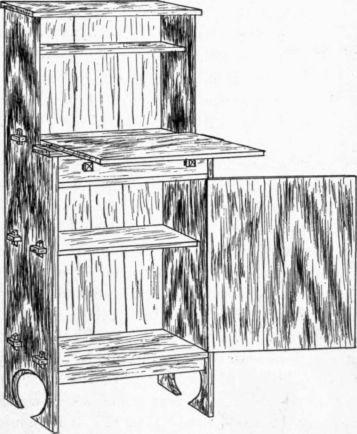
The tongues projecting through the side pieces are 1 7/8-" long and 2" wide, the holes for the pegs being 5/8" square. The outer edges of the tongues are 3" from either edges of the side pieces. It will be best to cut the holes first and then locate and cut the tongues. The pegs are 2" long. The lower holes are 6" from the floor, those for the shelf above, 17" from floor ; the hole for the shelf above the drawer lines with the cut previously mentioned. The drop lid for the upper part is 21 1/4" long and 15 1/8" wide. To keep this from warping, rabbet the inner edges of the ends and glue on strips 2" wide and 1/2" thick, which are not shown in the illustration. If perfectly dry stock is obtainable, and same planed on a jointer to take out the wind, these strips can be omitted. The hinges are hung on the lower edge, and do not show. A spring catch at the top keeps the lid closed.
The door for the lower part is 17 1/4" high and 21 1/4" wide, the grain running vertically, consequently it will have to be glued up from two pieces. It is hung with hinges suitable to the wood used and finish, hooks for hot water bottle, etc., being placed near the top on the inside. Suitable catches are fitted, and locks also are desirable if small children are likely to make tests of the medicines there stored.
Continue to:


My Books

