


Carrom Bowling Alley
Description
This section is from the book "Amateur Work Magazine Vol3". Also available from Amazon: Amateur Work.
Carrom Bowling Alley
A particularly desirable feature of this alley is, that the pins and shooting point are both at the same end of the board, thus avoiding the necessity of constantly moving to the other end to set up the pins and recover the balls. For that reason it is attractive to a single player.
The bottom A, of white-wood is 48" long, 15" wide, and 3/4" thick and should be planed on a surfacing planer to ensure that all wind or uneven places are taken off. Four oak or maple cleats 14" long, 4" wide and 7/8" thick, are then screwed across the under side to keep the surface of this board perfectly true, one 2" from one end, one 6" from the other end, and the two others equally spaced between or about 11" apart. The bottom board is then cut out at the end on the end C to form a pocket by sawing off a piece 5" with the length and 12 1/4/" across, leaving a projection 3" wide and 5" long. Save the piece cut off to use for the bottom of the pocket. Two side pieces B 49 1/2" long, 3 3/4" wide and 3/4 " thick and two end piects C and (7, 16 1/2' long, C 3 3/4" wide and C 8 1/2\" wide and 3/4" thick, are then firmly screwed to the sides and ends, the joints being mitred. The wider end piece C is for the end with the pocket.
A piece D 12" long, 4 3/4" wide and 3/4" thick is then screwed to the inner cross edge of the pocket, the edge being just flush with the bottom board.
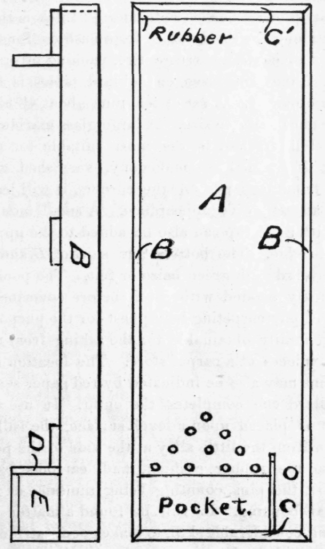
Two side pieces -E, the outer one 6 1/2" long, and the inner one 5 3/4" long, 4 3/4" wide and 3/4" thick, are then fitted to the sides of the pocket. The outer piece has mitred corner at the joint with C, but laps over on piece D. The inner one laps on D and is fastened to C and A by screws put through from the outside, the heads of all screws being deeply countersunk. It will be noted that the inner piece E projects into the pocket 1/4', the space above it being filled by the partition. The joint between E and B would look best if glued, but if carefully fitted this need not be done, as there is ample strength without. The bottom board is then put in and nailed firmly with wire nails through C, D and E.
The partition board F is 7" long, 3 3/4" wide and 1/4" thick, the inner end being cut to an angle of 20°, and also cut away on the under edge to fit over the board A where it projects beyond the pocket. It is fastened by nailing along the lower edge to A, at the end to C and a nail on the other end drawn into A. Two legs 4 3/4" x 2" x 3/4 " are screwed to the cleat, at the C end, to level the board.
A strip of rubber §" wide and 1/2" thick is then glued along the inside of C for a cushion for the ball; a piece of a carriage tire, packing or other form, if the kind used on billiard tables is not easily obtained. A set of ten pins about 4" high is the most suitable size. A large glass marble or small billiard ball is the most suitable for the ball. If stained in mahogany, varnished and brass trimmings put on the corners, it will have quite an attractive appearance. A small moulding with a flat top can also be added to the upper outside edge. The bottom and sides of B and C are covered with green baize or felt. The pocket is thickly padded with cloth before covering, a piece of pile carpeting being best for the purpose, and generally obtainable for the asking from the waste pieces of a carpet store. The location for the pins may also be indicated by red paper seals. A billiard cue completes the outfit. In use the board is placed upon a level surface, the ball is driven from the little alley at the side of the pocket to the rubber cushion, and carroms back against the pins, counting being the same as for regular bowling. It will be found a matter requiring considerable skill, to make good " strikes," and a decidedly interesting game to play.
Continue to:


My Books

