


Joints In Woodworking. III. Mortise and Tenon and Dowelled Joints
Description
This section is from the book "Amateur Work Magazine Vol3". Also available from Amazon: Amateur Work.
Joints In Woodworking. III. Mortise and Tenon and Dowelled Joints
FRANCIS L. BAIN
The style of joint to be used in door, sash and blind work and other work of a similar nature depends largely upon two factors, namely: thickness of material to be used, and purpose for which the completed work is to be used. For instance, if the stiles and rails of a heavy door were 1 5/8 in. thick the use of dowels as the only means of joining would not be practical, as the unusually heavy strain and the constant moving of the door would eventually dislodge or weaken the dowels. On the other hand, if the frame for the door of a bookcase or wardrobe is being made, maple dowels are usually amply sufficient if properly glued in place, as the stock is so much thinner and lighter, thus relieving a great deal of the strain previously referred to.
In connection with the purposes for which the completed work is to be used, a good argument in favor of mortise and tenon joints can be derived from the con-sideration of a window frame with the constant jars and moving which many of them have. In this case the dowels would almost certainly become dislodged by the vibration, while the mortise and tenons would weaken very little, if at all. Dowels are, however, very commonly used in connection with this joint, being driven right through it from one side of the stock
From many true and tried suggestions concerning the two varieties of joints above referred to the following have been chosen as the most practicable and valuable:
Referring to Fig. 1. The distance a should never be less than the thickness of the stock 6, as a lesser distance would weaken the stock at that point and perhaps cause a breaking out of the dowel later, or at least a fraction of the stock near the dowel.
A dowel should be inserted into each of the pieces it joins at a distance equal to at least twice its diameter, whenever possible.

Fig. 1.
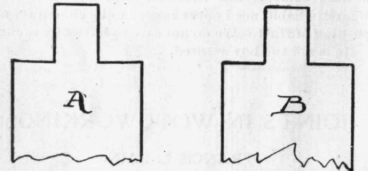
Fig. 2.
The thickness of the tenon in a mortise and tenon joint should usually be one-third that of the stock from which it is formed, and the mortise should, of course, be a corresponding width. The shoulders of the tenon, properly made, should be exactly square across as shown at B, Fig. 2, but many amateurs find " chiselling to a line " rather irksome, and for the benefit of such a very slight concave is allowable, as shown at A, Fig. 2.
Unless joints are intentionally made to be taken taken apart, as in the case of halves of patterns, they should be thoroughly glued, as this adds 60 per cent, to the strength of the joint. Mortises and tenons should also be carefully glued, unless there is some reason for putting together without the gluing.
The next chapter will deal with the halved and dovetail halved joints.
Continue to:


My Books

