


Two Electrical Formulas
Description
This section is from the book "Amateur Work Magazine Vol3". Also available from Amazon: Amateur Work.
Two Electrical Formulas
There are two formulas for electrical measurements which every amateur electrician should memorize. They enter into all sorts of calculations in telephone, telegraph, electric light and general experimental work.
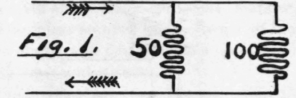
First: - The combined resistance of two parallel circuits, may be found by multiplying the resistances together, and dividing by the sum of these resistances. Where there are several circuits in parallel, any two are treated thus, and the result combined in the same way with the resistance of another circuit, and so on to get the final resistance. For example : - The amateur has planned a circuit as in Fig. 1. One shunt measures 50 ohms, and the other, 100 ohms. The combined resistance will be equal to 50 x 100, ÷ by 50 + 100, = 33 1/3 ohms. If the amateur should conclude to add on another shunt of say 2 ohms, (see Fig. 2,) he should consider the problem resolved into two factors, the 33 1/3 result of the previous calculation, and the new shunt of 2 ohms, = 33 1/3| x 2, % by 33 1/3 + 2.
Now it becomes evident to the amateur, that, knowing the combined resistance of these shunts, he may calculate by Ohms law (C =: E % R,) just what effect this combined resistance will have on the amount of current. Yet it must not be presumed that any one of these shunted resistances is to carry more than its prescribed portion of the current. And to ascertain just how many amperes each shunt is taking we must follow a rule that, in such a divided circuit, each shunt carries a proportion of current, inversely proportional to its resistance.
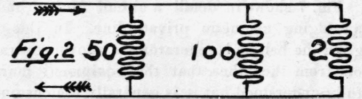
In explanation, note down for each branch or shunt, the reciprocal of its resistance. Then reduce these fractions to a common denominator, and add the numerators together. Use this sum of the numerators for a new common denominator, and the original individual numerators as numerators, and the resulting fractions will show what part of any current that may be in use will pass through any one of the shunts. For example, using the shunts of the previous example : 1/50, 1/1000, 1/2, common denominator, is 100. New fractions become 2/1000, 1/1000, 5/1000= 53. Following the rule above given, we calculate that the first shunt of 50 ohms carries 2/53, the second or 100 ohm shunt, carries 1/53 and the last, or 2 ohm shunt, carries 50/53. The total, or 2/53 + 1/53 + 50/53 = or unity.
Continue to:


My Books

