


A Window Ventilator
Description
This section is from the book "Amateur Work Magazine Vol4". Also available from Amazon: Amateur Work.
A Window Ventilator
John F. Adams
The proper ventilation of the living and sleeping rooms of a residence during snowy or rainy weather, requires some arrangement which will permit the fresh air to enter and yet keep out snow or rain. It is also desirable to be able to close the window without having to remove or adjust the ventilator. The arrangement here described possesses these requirements, and is also quite easily made at small expense. Its general construction can be seen from the illustration, and as windows vary so greatly in size no dimensions will be given, as anyone making it can readily determine what they should be to fit the windows where they are to be used.
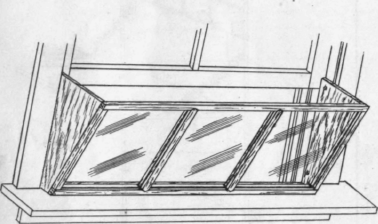
It will be noted that the front side is at an angle of about 65° from the vertical, so that the simple raising or lowering of the window is all that is needed to regulate the volume of air entering the room. Also, as the upper edge of the ventilator is higher than the lower edge of the window the air current takes an upward turn, and snow or rain will fall against the glass front and thence to the bottom. In very windy weather the window is raised only sufficiently to admit the air.
For windows of ordinary size the height of 10 in. will answer ; the two end pieces then being 10 in. high, the upper ends 6 1/4 in. wide, and the lower ends 2 in. These are connected with a narrow piece at the bottom 2 in. wide and 1/4 in. thick. The frame for the panes of glass are made of strips 7/8 X 5/8 in., in which 3/16 X 3/8 in. rabbets have been cut where necessary. The corner joints at the ends are halved; the two dividing pieces are fitted with V-shaped ends, the proper grooves being cut in the long pieces to receive them. They are permanently fastened by boring 1/8 in. holes and pinning with dowel pins glued in. The frame is then fastened to the ends and bottom strip with wire finish nails.
The panes of glass are held in place with strips of wood, which should just fit the remaining space so that the edges will be flush with the frame. These strips are nailed with small brads. Those on the lower part should be bevelled to avoid forming a ledge, which would hold the rain or snow running down the glass. For the same reason, the bottom board might be inclined slightly. The only varnish which will stand the elements is spar varnish, two coats, at least, being necessary. The ventilator is fastened to the window by two screws put through each end piece, one near the top and the other near the bottom.
Continue to:


My Books

