


Book-Binding For Amateurs. VI Rounding: the Back
Description
This section is from the book "Amateur Work Magazine Vol4". Also available from Amazon: Amateur Work.
Book-Binding For Amateurs. VI Rounding: the Back
WINTHROP C. PEABODY
The sewing completed, an examination should be made to ascertain that all sheets, plates, etc., have been securely fastened. The next operation is the addition of the end papers, or what are commonly termed "fly leaves". These are the blank pages to be found at the front and back ends of all bound books. In the finer binding a white paper similar to that of the book, but slightly thicker, may be used, or a tinted paper, if desired.
When folded once in the middle the size should be that of the book. The fold should be pressed down with an ivory, thin glue spread along the edge of the fold and then placed evenly on the book, a board and weights being placed over it until dry. But little glue should be used, just enough to firmly fasten in place along the whole edge.

Ready for Laying Press.
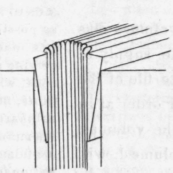
After Backing.
It will be necessary at this point to distinguish between grades of work, as much labor can be saved on books which are bound largely for the sake of keeping them in permanent shape, and without special desire to secure a fine appearance. With books of this class we can at once proceed to have them trimmed on the paper cutter of some printer friend, first having "jogged" the back perfectly flat, and marked in pencil on the top page, lines showing where the knife is to cut.
With books of more value and finer bindings, this trimming is done "in boards," or after the boards have been attached and other work done, and this method will be described later.
After trimming, the backs are "rounded up," which also has the effect of giving the front a concave form, making a better appearance than when flat, and also easier to turn the leaves when reading. This operation is one requiring some experience and skill before it can be done quickly, but with the exercise of patience and care, no great difficulty will be met with. The experienced binder will partly work up the back with a few turns of the hand, but the beginner can do nearly as well if he will provide himself with some strips of wood, the upper surface of which has been rounded to the arc of a circle with diameter of about twice the thickness of of the book. Holding the book at the ends with both hands, jog the back on a flat, solid surface until it is even, turn the book over and jog the front edge on the rounded surface of the rounded strips. This will give the back the desired curvature, using care that the curve is even throughout.
Holding the book, with the back rounded, in the left hand, a backing board is placed on one side, with the edge of the board about 1/8 in. lower than the back. Another backing board is then placed on the other side of the book, and book and boards placed in the laying press or vise, which is screwed up tight, as shown in the illustration. Backing boards can be made from cyyress clapboards of even grain, the thin edge being cut off and the thick edge beveled.
The back of the book is then covered with thin glue, applied with a brush, working the glue into the back sufficiently to hold it securely and yet not enough to run down into the leaves and make the back unduly stiff. The glue is then allowed to dry until it is almost hard, or until all "tackiness" has disappeared and will not stick to the hammer. With a flat-headed hammer, much like those used by shoemakers; the edges are then hammered outward a little at a time and working all along the edges until they are bent to the extent of the thickness of the boards used for the cover. The motion given the hammer is much like that used in heading over a rivet, but care must be used not to strike with the edge or the paper will be cut. It must also be done gradually, or creases and breaks will result. A little practice will soon show what is needed.
The backing being completed, apply another very thin coating of glue, then put on a strip of thin, tough paper, of a size to just cover the back, except about 14 in. at each end. If unable to obtain the special paper used for this purpose, a thin, strong manila paper will serve. Again apply thin glue to this covering of paper and put on the strip of backing cloth, the size being such as to come within 1/4 in. of the ends of the book and projecting to either side from 1 to 1 1/2 in. according to the size of the book. When the glue is quite dry, remove from the press, for further work, which will be described in the next chapter. The process here given is that suitable for binding of magazines, or where only plain, rapid work will answer. The backing of books of a more valuable and attractive character is done in a slightly different way, to be taken up in a subsequent chapter.
Continue to:


My Books

