


Elementary Mechanics. X. Compressed Air. Continued
Description
This section is from the book "Amateur Work Magazine Vol4". Also available from Amazon: Amateur Work.
Elementary Mechanics. X. Compressed Air. Continued
A. COOLIDGE
Fig. 35 represents a student lamp chimney which may be procured at a grocer's or hardware store, with a piston P just large enough to move easily in the tube. The piston may be cut out of cork or soft wood, and will work better if it is made to fit loosely and then wound with soft string to a fairly tight fit. A rod and handle H must be fastened to the piston P. This can be done by boring a hole not quite through P and fastening in with a long, slender screw. Experiment XXXIV.
If the piston P, resting on the level of the water, is raised, as no air can pass through it, the space O below it will be either a vacuum or will be filled with water ; we find the latter to be the ease, and also that the water will rise as long as the piston is lifted. Some force drives the water up after the piston. Experiment XXXV.
Take the discarded bulb of some electric lamp and holding its tip under water, break it off with a pair of pliers. If a small hole is made the water enters in a little fountain shaped spray until the bulb is filled, The force driving the water upward in both of these cases is the weight of the air pressing upon the surface of the water and, as we have before learned in all fluids, changing its downward pressure into lateral and upward pressure; it drives all fluids before it and forces them to enter any spaces not already filled with other matter. Could our lamp chimney be made 34 ft. high, and be strong enough, the water would rise to that height and then refuse to go further. A tube of the same kind in a jar filled with mercury or quick-silver need be but a little over 30 in. long for a similar experiment and illustrates the action of a barometer We should make one for ourselves from a description published in the September, 1903 number of this magazine, to which readers are referred or, at any rate, study its construction from one already made.
It will be noted that the tube contains a column of mercury about 30 inches high. The space above the mercury is a vacuum, i. e., it contains nothing except a very little mercury that has changed to a vapor. As the word barometer signifies an instrument for measuring air pressure it must be shown in a rise or fall of the mercury. If the air becomes heavier the mercury ises; if lighter, the mercury falls. But what causes any change in the airs' weight or pressure ? Any change in the amount of vapor in the air causes a change in the air pressure. A falling barometer indicates a storm, although many local distubances may occur without such a change in the weather. A rising barometer foretells pleasant weather.



Another use of our barometer is to tell the height above the sea level of different places. As it is the weight of the air pressure upon the mercury in the cistern that balances the weight of the mercury in the tube, any change in the weight of air will make the mercury column higher or lower. Therefore, the higher one ascends, as in climbing a mountain or in a balloon, the less air there is above, consequently the less will be the pressure or weight of the air on objects. The mercury in a cistern of a barometer will have less pressure on it the higher we ascend, and consequently the column of mercury in the tube will be shorter.
Suppose we should start at the foot of a high hill and with a convenient barometer ascend the hill. If the barometer column were 30 inches when we started, and as we climbed the hill fell to 29 inches, we should know that we had climbed a vertical distance of over 940 feet, and the barometer would register one inch less for every such distance we climbed.
On Mt. Blanc, about 3 miles high, the barometer is only 15 inches, and we see by this that the above rule for one inch fall holds good only for a short distance. We see also that if the barometer is only half its usual height on t. Blanc, that one-half the earth's atmosphere is within three miles of the earth's surface and that it is very thin above that distance. The distance in level of the top and bottom of a high building will show itself in a barometer.
A more convenient form, called an Aneroid barometer, in the shape of a small clock, is made. This is the form usually carried by mountain travellers. Some are even as small as a large watch. They have a single band or index and contain within a small tin metal box from which the air has been exhausted. The air presses upon this box and shows an increase or decrease by moving the pointer of the barometer. The barometer's height in inches is marked on the dial, as the hours are marked on the face of a clock. Such a barometer can be carried in the pocket and is an instrument of much convenience and value to a mountain ciimber.
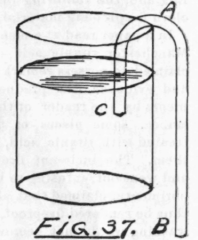
In some of our former experiments we used a piece of rubber tubing about two feet long. If we do not have one a three or four feet length of common garden hose will admit of the following experiment being tried on a larger, coarser scale. A glass tube, 12 inches long, as shown in Fig. 37, bent so as to have one arm longer than the other, will allow us to see better what takes place in the operation of a syphon.
Experiment XXXVI.
Fill the tube with water and with the thumb covering the opening C, put it down into a jar of water. There is more water in the arm A-B than in the other arm, A-C, consequently the greater downward force is in the arm A-B. The water in A-C, instead of flowing out at C, is forced by the air pressure to rise toward A, and this continues as long as there is water in the jar above the opening, C. With a rubber tube a tub or barrel may be emptied. Syphons are of great use in emptying barrels where there is a sediment in the bottom, such as vinegar. The liquid is drawn off through the tube without stirring up the dirt at the bottom.
A very interesting form of syphon is what is called an intermittent spring. In one of our former experiments we had a large-mouthed bottle with the bottom removed; with a small glass tube, bent as in the figure and run through a tightly fitting cork, our apparatus is complete. Water may be poured into the bottle without running out until it rises above the level A. Then it begins to run out at B and and continues to run until the leveal again reaches the opening of the tube C. It will then cease running until the level A is again reached.
An intermittent spring may be flowing in dry weather and dry in rainy weather, because, as the water in some natural reservoir has not had time to fill the cistern, and as it may not rise above the bend in the natural bent passage or syphon tube until long after the rain has ceased, the water will not begin to flow until the level corresponding to A in our figure has been reached. This may take so long after the rain that a spell of dry weather comes, and the reservoir may be so large that the water will continue flowing through a period of very dry weather, and ceasing to flow only about the time that another rain storm appears.
Continue to:


My Books

