


Junior Department. A Simple Galvanometer
Description
This section is from the book "Amateur Work Magazine Vol4". Also available from Amazon: Amateur Work.
Junior Department. A Simple Galvanometer
Philip C. Holden
Any of the younger readers of this magazine who may desire to construct a galvanometer, will find the one here described quite easy to make and sensitive in action with the small currents to which its use is restricted.
The baseboard, B, should be made of oak or maple and is 5 x 2 1/2 x 1/4 in. Two other pieces, C and D, upon which to wind the coils, are 2 1/2 x 2 1/2 x 1/2 in. Around the edges of these two pieces cut flat grooves, 1/4 in. wide and 1/8 in. deep. In the center of the piece D bore a hole 1 in. in diameter. The grooves are then filled with cotton covered magnet wire, No. 18 gauge, wound in even layers, the coils being each wound in the same direction and the ends joined as though both were but one coil. They are then fastened to the base board with brass nails, boring holes with an awl, or they may be glued, holding them down with clamps until the glue is quite hard.
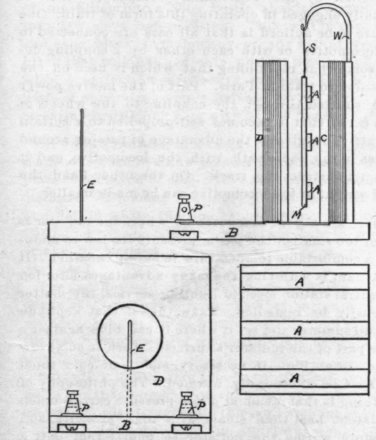
Two binding posts are mounted on the base board to which the remaining ends of the coil are fastened. At the top and at the back of coil C a piece of brass wire is inserted in a hole, previously bored, the free end being bent to a curve, as shown in the illustration, an eye having first been formed by filing the end of the wire flat and then bending.
A piece of mirror, M, made on thin glass 2 in. square, is then suspended by a silk fibre, 8, drawn from a piece of discarded bass string of a violin. The silk is attached to the center of the top edge of mirror with sealing wax. Before doing this attach to the back of the mirror three pieces of thin spring steel, A, 2 in. long, Jin. wide, spaced in apart. To do this coat oneside with shellac, place against the mirror and hold in position until the shellac sets, which takes but a few moments. These pieces of steel should be previously magnetized, care being taken to mark the N pole on each and to have the same poles on the same side of the mirror.
One half inch from the other end of base board, bore a small hole and place therein a polished steel wire 1 3/4 in. long, above the surface, (a piece of a knitting needle will serve.)
In using the instrument place in such a position as regards the polarity of the earth that the mirror will be exactly parallel with the coils. This can be ascertained by sighting from the needle through the hole in D and observing when the reflection of the needle is exactly connecting the current to be tested, the mirror will turn because of the influence of the coils on the magnets.
Continue to:


My Books

