


The Interruption Of Primary Currents. In Ruhmkorff Coils
Description
This section is from the book "Amateur Work Magazine Vol4". Also available from Amazon: Amateur Work.
The Interruption Of Primary Currents. In Ruhmkorff Coils
Oscar N. Dame
In connection with the operation of induction or spark coils, we find the interrupter he easiest part to manufacture, but the most difficult to design to meet the condition of the coil with which it is to be used. With small coils, using a battery of from four to ten dry cells, an apparently trifling change in the length of a vibrator, the weight of the head, the position of the platinum contacts or the back tension or throw causes a wide variance in spark results, and quite often from lack of understanding the cause of some trouble, a coil is condemned because the designer or manufacturer used a " stock " vibrator, instead of building one adjustacle to the primary and secondary conditions.
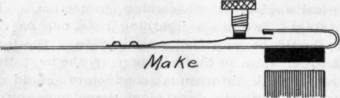
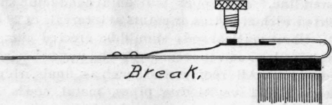
Fig. 1.
As in the designing of motor and dynamo armatures, special attention is given to permeability, etc.; so is it with primary cores, and the best material for a primary core is the finest grade of annealed iron wire, bundled into proper cylindrical form and dipped in shellac. No. 24 or 26 Swedish iron gives superior results.
The purpose of the primary winding is to furnish the proper number of conducting turns to energize the core and make a powerful magnet of it, and usually the best results are obtained with not over four layers. In planning the number of layers one must consider the space occupied by the secondary windings, for sufficient lines of force must be generated to reach the maximum number of turns in the secondary, so that the full value of the spark may result, yet on the other hand, the more turns on the primary the greater the resistance, the inductance, and in general the more sluggitsh the coil action. We find that the more turns we have on the primary, the greater the spark at the platinum points of the vibrating interrupter, and to care for this spark which, of course, is a result of intense primary saturation, we of necessity must place a larger condenser capacity in micro-farads across these points.
The higher the resistance of the primary, the less amperage available from the battery supply, and also the less likelihood of quick exhaustion of these batteries.
For a standard one-inch spark coil, operated by four dry cells, the vibrator is usually two inches in length, where the primary windings are not over three layers, which gives sufficient time for the " make " to allow the current to make a strong electro-magnet of the core. While electricity in itself is treated generally as instantaneous in its performances, in spark coil operation we find time an important factor. For example, a vibrator only two inches in length if connected to a six-inch coll, would not give satisfactory results because, owing to the very high speed of vibration of such a short piece of spring metal there is not suffi-cient time on the "make" and before the " break " to permit the primary to become properly saturated, and with the "break " of the circuit there is not sufficient time for demagnetization before the make occurs again. On the other hand, if we were to use a four inch vibrator on a one-inch spark coil, the result would be a splitting, lifeless spark, making the inch spark at times, but valueless for practical uses.
In all sizes of induction coils, the spark value is determined by the instantaneous break at the proper time, often styled the long make and the quick break. All good vibrators are devised to make sudden break of contact at the proper moment, and this is usually accomplished by attachments connected to the vibrating part itself, which " kick " off the spark just as the vibrator is moving at its highest rate of speed. Figure 1 illustrates the principle of this "kick, " different manufacturers applying different methods to accomplish the same result.
It will be noted that the lip is bent over from the head and does not strike the piece bearing the platinum contact until the vibrator is well down to the core, and by proper adjustment this kick will happen when the speed is the greatest.
On coils larger than three inches, core actuated interrupters are seldom used, because separately actuated magnetic interrupters give better saturation and a more instantaneous break. Figure 2 shows a vibrator frequently seen on moderately sized battery coils, and the spark results are far better than could be obtained with a vibrator actuated by the coil core. Cores on large coils possess sufficient instantaneous magnetism to act on the hammer head of a core-actuated vibrator as soon as the current enters the primary. Consequently the length of beat, which is commonly governed by the length of the vibrating metal, is not hereafactor. With a separate vibrator coil, wound with a few turns of suitable wire, the electro magnetic value of this coil does not reach a maximum as promptly as in the coil primary, so the hammer head is not attracted until the coil itself is in readiness for the break. And because of the low resistance winding of this vibrator coil, and the few number of turns, neither resistance can affect the amperage of the primary to any extent, nor retard the reversals at the interruption and re-contact.
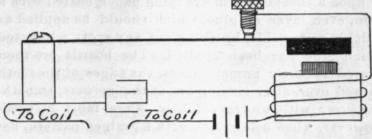
Fig 2.
Continue to:


My Books

