


How To Make An Electro-Magnet
Description
This section is from the book "How To Make Common Things. For Boys", by John A. Bower. Also available from Amazon: How to Make Common Things.
How To Make An Electro-Magnet
You know what an electro-magnet is? It is a piece of iron that becomes a magnet only when it has what is called an electric current passing through an insulated wire surrounding it. As soon as the current is taken off, it is merely iron again, without any magnetic properties.
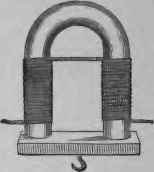
Fig. 144. - Electro magnet and keeper.
Get a rod of iron ½ inch in thickness, and between 8 and 9 inches long. Heat the centre of rod to redness. Then by means of a hammer, beat it into the form of a horse-shoe, as in Fig. 144. If you cannot get to an anvil, you can work it on a block of iron, holding one end in a pair of tongs or pincers. If you cannot do it neatly, get it done for you. A smith will do it for a few pence; and if you stand and look on while he does it, you will get a lesson into the bargain, and be the better able to try your skill on a second piece of iron. When the iron is quite cold - let it cool gradually - put it into a vice, and smooth off the ends with a file; use rather a coarse one at first, then a finer one, so that the ends are quite smooth. Then take about six yards of fairly thick covered copper wire - as thick as ordinary bell-wire - and wind it neatly round the legs of the magnet, keeping the wire always in the same direction, and the coils close together, as in Fig. 144, and tight to the rod. If you want a still stronger magnet, put a second coil over the first, keeping it in the same direction.
Twist the ends of the two wires on each leg together. To make it look neat, and to cement the layers of wire together, cover it over with a thick layer of philosophers paint, mentioned in Chap. XII. The bare iron may be covered with the same, or with some enamel paint of another colour. The battery-wires are attached to the ends of the coil on the iron, and you will find you have a strong magnet by using two or three of your battery-cells. Refer to your Science book for a good series of experiments to try with this magnet.
How To Solder Together Wires And Flat Metallic Surfaces
We refer you to Chap. XL The electro-magnet will be better for having a pair of binding-screws soldered on the ends of the wire; and the galvanometer will look neater if the wires from the coil which surrounds the needle passes directly through the stand, and are soldered to the ends of a pair of binding-screws which pass through the board. Four little square blocks of wood glued at the under corners of the galvanometer-stand will give firmness, and also improve its appearance.
How To Make A Keeper To The Electro-Magnet
Get a piece of flat iron cut off long enough to extend just beyond the poles of your magnet. File it up so that the surface next the magnet is quite smooth and flat. Get a screw-hole drilled into the under side, and then put a hook into it, as in Fig. 144.
Continue to:


My Books

