


How To Keep Your Knife Keen
Description
This section is from the book "Things To Make In Your Home Workshop", by Arthur Wakeling. Also available from Amazon: Things to Make in Your Home Workshop.
How To Keep Your Knife Keen
Take out your pocketknife, open the most used blade, and hold it vertically before you as illustrated in Fig. 9. Your back should be toward a strong light.
Scan the edge carefully from tip to base. Is it one long, bluish, indistinct line, so thin that it seems more imaginary than real? Or is the edge in places quite clear and distinct, like a white line? If it is, the blade has lost its keenness. To what extent, you can judge by the width of the white line.
Test it further by drawing the ball of the thumb lightly at right angles across the edge. If you notice a slight clinging effect, the blade is sharp. If it slips over the flesh very easily, it is dull.
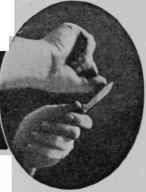
Next, draw the edge of the thumb nail along the blade (Fig. 10). A sense of friction indicates that the blade is keen. If there is the most minute nick, the test will reveal it.
There is still another test - one especially valuable when you buy a new knife. Take along a small hardwood block, say beech or maple, and, after picking out the style of knife you want, ask the salesman for permission to cut a thin shaving across the end grain. If the blade is too soft, it will bend over along the edge and a sort of hook wall be felt when the thumb is drawn across one side or the other of the blade. If, on the other hand, it is too hard, small particles are apt to break off the edge, leaving it ragged. If the blade is correctly tempered, tough and hard, the edge will remain keen and undamaged.
The best of knives, however, will not long give good service unless they are kept sharp. Deep nicks should be ground out on a grindstone or an emery wheel. Lay the blade flat upon the tool rest so that the edge will fome squarely against the wheel. Press lightly and draw the blade slowly and evenly back and forth across the stone.
When you are satisfied that the edge is true, set the rest at the proper beveling angle, or hold the knife freely in the hand at this angle, and grind down both sides, moving the blade constantly across the face of the wheel while so doing. Exert very light pressure so as not to overheat the edge. Water should be poured on a grindstone during this process, and, in the case of an emery wheel, upon which water is never applied, the tool should be dipped frequently in water to cool it off.
Blades need to be reground only when very dull. Ordinarily it is sufficient to hone them on an oilstone. Indeed, even when they have been ground, the sharpening must be finished on a stone.
Slight nicks can be removed by placing the edge down squarely on the oilstone and working it back and forth. Clamp the stone in a vise or otherwise fasten it down, if possible, and lubricate the surface with clear oil, kerosene, or a mixture of olive oil and kerosene.
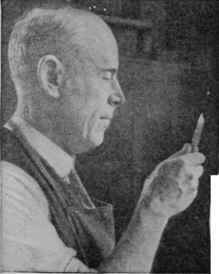
Fig. 9 (at left). - Scrutinizing the cutting edge to note the width of the white line.
Fig. 10 (below). The thumb-nail method of testing sharpness.
One method of honing is to place the blade across the center of the stone in such a way as to give the longest possible bearing upon the cutting bevel and lay the 'tips of two fingers of the left hand upon the upper side of the blade (Fig. 11); work the steel back and forth from end to end of the stone, keeping the angle as shown in Fig. 12. While it requires considerable practice to do properly, some experts, instead of holding the blade flat, lift the point slightly above the stone and draw the knife with a slanting stroke so that it is sharpened from heel to point by contact with the stone along a relatively narrow path near the edge of the stone. This is easier to do than describe, and is so effective that a stroke or two, expertly given, will sharpen the edge to factorylike perfection.
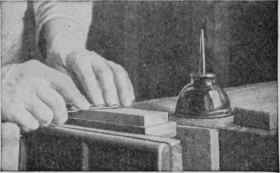
Fig. 11. - When honing a knife, take long strokes back and forth on the oilstone, turning the blade at each stroke and sharpening against the edge. In other words, the cutting edge is pushed forward.
After honing both sides of the blade, wipe off the surplus oil and test for wire edge by drawing the sides slantwise across the ball of the thumb. If considerable honing has been done, one or the other side of the blade will have a sort of hooked roughness where the exceedingly thin edge has been bent over. This wire edge can be removed in two ways. One method, a rough and ready one, is to hone it down with lighter pressure. The other, for finer results, is to strop it off by "wiping" the blade upon a piece of oiled leather or an oiled basswood block. A mechanic sometimes strops the blade on the palm of his left hand.
Oil the blades and joints lightly with a good grade of thin machine oil. Avoid cutting apples, oranges and lemons with the knife, but, if it must be done, be sure to wipe the juice off with a dry cloth. If water gets into the knife, dry the blades and the interior at once.
To remove rust or discoloration from the blades, rub them with fine emery cloth moistened with kerosene.
Incidentally, notice the uses to which you commonly put your pocketknife so that when you go to buy a new one you will be able to select the size and style of blades that will best serve your purposes.
For ordinary whittling and all-around cutting the spear point blade, called a pen point in the smaller sizes, is considered the best. The clip point is useful for working in recesses and for carving. The bevel point is excellent for cutting paper, cardboard and cloth, and it is also a good veiner and chipper for carving. The sheep-foot point is useful for sharpening pencils, scribing, and some types of carving. The Wharncliffe can be used for the same work, but possesses a slimmer point. The various saber points are for heavier cutting. Farmers, nurserymen and those interested in gardening will find a pruning blade of advantage, and a budding blade has no superior for grafting purposes.
Another important consideration is to buy a pocketknife that will open easily, yet with blades that will spring shut when about two thirds closed.
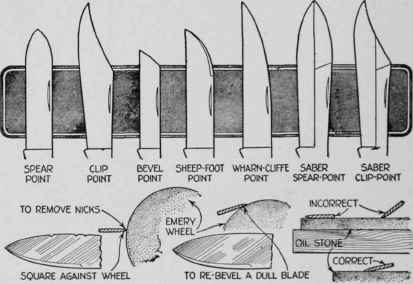
Fig. 12. - Some of the more common shapes for pocketknife and ■jackknife blades; how to remove nicks and regrind and hone a dull blade.
Continue to:


My Books

