


Sketching-Frames
Description
This section is from the book "Wrinkles And Recipes, Compiled From The Scientific American", by Park Benjamin. Also available from Amazon: Wrinkles and Recipes, Compiled From The Scientific American.
Sketching-Frames
A square frame is hinged to the top of an ordinary drawing lap-board, so that it will stand in an upright position (as in Fig. 1). Across this is stretched a number of threads or wires at equal distances apart so as to divide the interior space into small squares. The paper on the board is similarly divided by light pencil-lines ruled over the surface. In making the sketch, the artist draws so much of the view as he sees through one of his squares in the frame, into the corresponding ruled square on the paper, and thus having a large number of straight lines to refer to is very readily enabled to locate the details of the picture. It is, however, necessary to use but one eye when looking at the landscape, and to keep this eye always at the same place, for which purpose an additional eye-piece may be added, simply consisting of a ring supported on a stand.
Simple Apparatus For Out-Door Sketching
Provide a small table with drawer; mount two grooved movable uprights at one end, with glass between the grooves; place an upright with a small eye-hole at the opposite end of the table, as shown in the engraving. Wash the glass with a thin solution of gum arabic and rock candy (20 parts gum to 1 of. candy). When the glass is dry, it is ready for use. Look through the small hole to get the object subtended by the glass, and with a soft crayon outline the subject on the prepared surface; remove the glass and lay it over your sketch. If you require the outline, you Should have a Becond plate NFC glass, and trace over it the reverse way with charcoal, then lay your paper on. and a little gentle rubbing will transfer the outline.
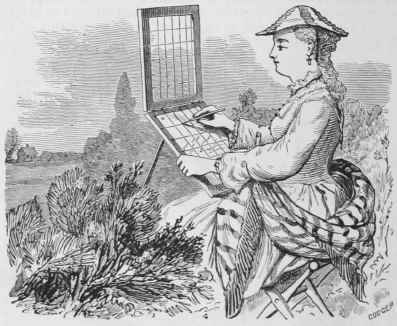
The Sketching-Frame
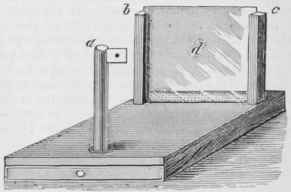
Out-Door Sketching Apparatus
Continue to:


My Books

