


Steam-Engine Governors
Description
This section is from the book "Wrinkles And Recipes, Compiled From The Scientific American", by Park Benjamin. Also available from Amazon: Wrinkles and Recipes, Compiled From The Scientific American.
Steam-Engine Governors
The ordinary pendulum governor consists of a vertical spindle, which is made to revolve by suitable mechanism, and carries, on opposite sides, a pair of arms, to which heavy weights are attached, forming revolving pendulums, which vary their positions at different speeds. The simplest form of construction is shown in Fig, 1, A B being the revolving spindle, Eand D the weights, secured to the spindle by rods jointed at G. Several positions of the halls are shown, corresponding to different speeds of rotation. In any of these positions, the vertical distance, as G F, of the point of suspension, G, above the centres of the balls, is called the height of the governor, and it can be found for any case by dividing 32, 508 by the square of the number of revolutions per minute. For instance, if a governor makes 100 revolutions per minute, running without friction or other resistance, the vertical distance of the centres of the balls below the point of suspension would be 32, 508 divided by 10, 000 (the square of 100), or about 34-1/2 inches. A table is added, showing the heights corresponding to various speeds.
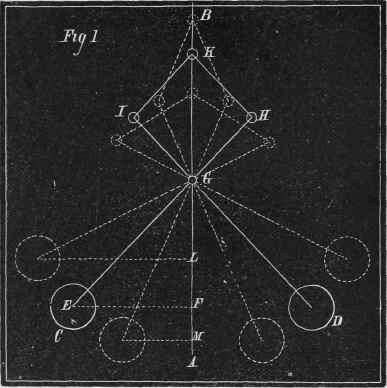
Table.
Revolutions per minute. | Height in inches. |
10........ | ....352.08 |
20........ | .... 88.02 |
30........ | .... 39.12 |
40........ | .... 22.01 |
50........ | .... 14.08 |
60............... | 9.78 |
70........ | .... 7.184 |
80........ | . . .5.501 |
90........ | ... 4.347 |
100........ | . . . .3.521 |
125............. | .......2.253 |
150........ | . . .1.564 |
175....... | .... 1.150 |
200....... | . . 0.8802 |
225........ | .....___ 0.6955 |
250........ | .... 0.5633 |
Revolutions per minute. | Height in inches. |
275...... | . . . .0.4646 |
300...... | . . . .0.3912 |
350...... | . .. . 0.2873 |
400...... | . . . . 0.2201 |
450..... | . ... 0.1739 |
500 ..... | ... 0.1408 |
550...... | ... 0.1164 |
600...... | .... 0.0978 |
650...... | . . . .0.08333 |
700..... | . .. .0.07184 |
750...... | . .. .0.06259 |
800........... | ..... 0.05501 |
850...... | . .. .0.04873 |
900...... | . .. .0.04347 |
950 | ..... 0.03901 |
1000...... | ___0.03521 |
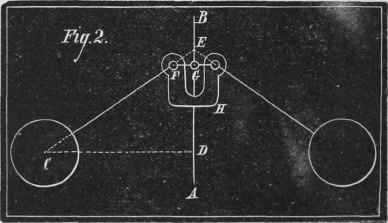
In practice, the pendulum governor is generally constructed somewhat as represented in Fig. 2, being connected to the controlling mechanism by short levers, so that a slight change in the position of the balls will move the regulator considerably. In estimating the height of the balls of such a governor, it is to be measured from E, where the centre lines of the arms produced cut the centre of the spindle.
When a governor.acts on the controlling mechanism of an engine, it encounters some resistance. There is also some friction of the moving parts, and a weight is sometimes added, either sliding on the spindle or connected to the spindle by a lever, in order to make the governor more sensitive. All these things in flucnce the height of the governor. In a well-made instrument the friction is insignificant, and need not be regarded, but allowances must be made lor the resistance, and the weight, if any is attached. Find how many pounds of force are required to move the controlling mechanism of the engine, and find the weight of the balls and of the attached weight, in pounds. Next determine how far the controlling mechanism is moved, and the attached weight raised or lowered, for a given change in the height of the governor balls. Divide the distance moved by the resistance by the change in height of the balls in the same time, and multiply the quotient by the measure of the resistance in pounds; divide also the vertical distance moved by the attached weight for a given change in the height of the balls, and multiply the quotient by this weight. Take the sum of these two products and the weight of the governor-balls, and divide by the weight of the governor-balls; multiply the quotient by the height for a governor working freely, taken from the table above; the quotient is the corrected height of the governor-balls.
Example
The two balls of a governor weigh 20 lbs.; the resistance of the mechanism is 10 lbs., and it moves 4 in. while the height of the balls changes 1/4 inch, The attached weight is8 lbs, and it moves 2 inches vertically, while the height of the balls changes 1 in. What is the height of balls for a speed of 200 revolutions a minute? Multiplying the quotient of | divided by 1/4 1/4 (4) by 10, the product is 40; multiplying the quotient of 2 divided by 1/4 (8) by 8, the product is 64; dividing the sum of 40, 64, and 20 (124) by 20, the quotient is 6.2; multiplying 6.2 by 0.8802 (the height for a free governor making 200 revolutions a minute), the product, the corrected height of the governor-balls, is about 5-1/2 inches.
In designing a governor, it is well to fix upon some range of speeds between which it shall control the engine, and make the balls heavy enough to effect this. The proper weight for the balls can be found approximately, as below:
(1) Divide the distance through which the resistance moves by the change in height of the governor-balls in the same time, and multiply the quotient by the resistance; divide the vertical distance through which the attached weight moves by the vertical distance moved by the balls in the same time, and multiply the quotient by this attached weight; add together these two products, and divide the sum by 2.
(2) Subtract the mean speed of the governor from the greatest speed it is to have, and divide the difference by the mean speed; divide the quantity obtained in (1) by this quotient: the result will be the weight of the two balls.
Example
Suppose the resistance and attached weight are the same as in the preceding example, and that the speed of the governor is to vary between 200 and 300 revolutions a minute, in controlling the speed of the engine. What should be the weight of the balls?
(1) The sum of 40 and 64 (the corrected resistance and attached weight) is 104; 1/2 of 104 is 52.
(2) The difference between 300 and 200 (100), divided by 200, is 0.5; the quotient of 52 divided by 0.5, or the weight of the balls, is 104 lbs., so that each ball must weigh 52 lbs. B.
Continue to:


My Books

