


A Novel Engine Regulator
Description
This section is from "Scientific American Vol. XL. No. 13. March 29, 1879", by Munn & Co. Also available from Amazon: Scientific American Science Desk Reference.
A Novel Engine Regulator
The accompanying engraving represents two different styles of regulator, invented by Mr. Stenberg, in which the effect of centrifugal force is utilized. In a vessel, A, of parabolic shape is placed a disk, C, which floats on glycerine contained by the vessel, and is attached to the walls of the vessel by an annular membrane, so that it may rise and fall in a vertical direction as the glycerine is carried with more or less force toward the edge of the vessel by centrifugal action. The inner surface of the vessel, A, is provided with radial grooves, by which the rotary motion of the vessel is communicated to the glycerine. To the center of the disk, C, is attached a vertical rod, which extends downward through the hollow shaft and is connected with governor valve. An increase of speed throws the glycerine toward the periphery of the valve, and, raising the disk, C, closes the steam valve; a diminution of speed permits the glycerine to fall back, when the disk descends and the valve opens.
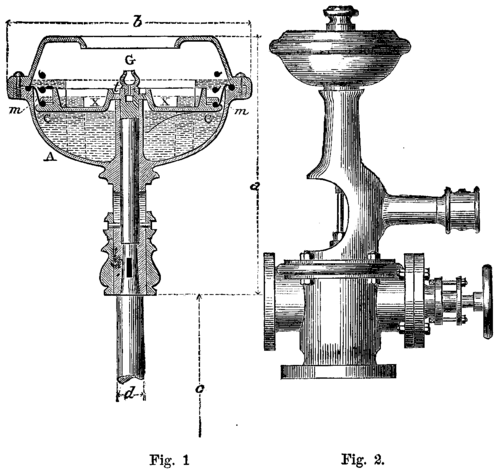
STENBERG REGULATOR.
The disk, C, has a small aperture for the admission and escape of air, and the apparatus is adjusted by pouring lead into the groove in the disk.
The regulator shown in Fig. 2 operates upon the same principle, but it is adjusted by means of a spring.
This apparatus is manufactured by Blancke Bros., Magdeburg. -Musée de l'Industrie.
Continue to:


My Books

