


Notes & Queries. Hints To Correspondents
Description
This section is from "Scientific American Vol. XL. No. 13. March 29, 1879", by Munn & Co. Also available from Amazon: Scientific American Science Desk Reference.
Notes & Queries. Hints To Correspondents
No attention will be paid to communications unless accompanied with the full name and address of the writer.
Names and addresses of correspondents will not be given to inquirers.
We renew our request that correspondents, in referring to former answers or articles, will be kind enough to name the date of the paper and the page, or the number of the question.
Correspondents whose inquiries do not appear after a reasonable time should repeat them.
Persons desiring special information which is purely of a personal character, and not of general interest, should remit from $1 to $5, according to the subject, as we cannot be expected to spend time and labor to obtain such information without remuneration.
(1) S. Q. - The speed of a circular saw at the periphery should be from 6,000 to 7,000 feet per minute. The number of revolutions per minute will of course vary with the diameter of the saw.
(2) T. J. F. asks (1) for the best way to fasten emery on a wooden wheel, to be used in place of a solid emery wheel. A. Cover the wheel with leather devoid of grease, and coat the leather surface, a portion at a time, with good glue; immediately roll the glued surface in emery spread out on a board. 2. How can I fasten small pieces of looking glass on iron? A. Use equal parts of pitch and gutta percha mixed together.
(3) W. C. asks: 1. What is the power of the simple electric light described in Supplement No. 149? A. When supplied with a strong current it is equal to 5 or 6 5-foot gas burners. It is designed for temporary use only. 2. What is the cost of manufacturing the dynamo-electric machine in Supplement No. 161? A. The one shown in the article referred to cost about $35.
(4) L. D. asks: 1. Which is the better conductor, silver or copper? A. Silver. 2. And the comparative resistance offered to the electric current by water and the above? A. Taking pure silver as 100,000,000, the conductivity of distilled water would be 0.01.
(5) H. J. F. writes: In Supplement 162 a simple electric light is described. I wish to light a room 20x20x10 feet. 1. How large is the bell glass? A. 2½ inches. 2. Can I use battery carbon? A. Use a carbon pencil made for electric lamps. 3. How can I make tray water tight after putting wire through? A. With gutta percha. 4. I have one large cell Bunsen and one Smee. How many more and of what kind shall I get? A. One of the batteries described in Supplements 157, 158, 159, will do, probably 8 or 10 Bunsen elements would be the best.
(6) W. B. F. writes: I tried to make an electric pen, like the one described in your Scientific American, of February 22d, 1879, using a Smee's battery, a circuit breaker, and an induction coil, but it did not work. Is there anything wrong, or is a condenser different from an induction coil? A. A condenser consists of a number of sheets of tin foil separated from each other by larger sheets of paper. One half of the tin foil sheets are connected with one terminal of the primary coil, the other half with the other terminal; the tin foil sheets connected with one terminal alternate with those of the other terminal. The condenser is essential to the working of the coil. For complete directions for making induction coils, see Scientific American Supplement No. 160.
(7) J. De F. asks: 1. Knowing the resistance of a wire of given conductivity, length, and diameter, will the resistance of any other wire be in proportion inversely? A. Yes. 2. Is there heat enough developed in the secondary coil of an induction coil to prevent the use of paraffine as an insulating material? A. With proper battery power, no. 3. How high in the list of non-conductors does paraffine stand? A. It is one of the best. 4. Will a cotton insulator soaked in paraffine answer as well as silk? A. No, because it renders the covering of the wire too thick. 5. Can you recommend any insulating material for making induction coils which will dry rapidly? A. Alcoholic shellac varnish. Rosin to which a little beeswax has been added is an excellent insulator; it must be applied in a melted state. 6. What is the composition of the black material covering the Leclanche porous cell? A. Gutta percha. 7. Is the magneto-electric machine described in the Scientific American Supplement patented? A. To which do you refer? Most, if not all of them are patented.
(8) B. V. F. writes: With reference to item 8, on page 139, of Scientific American, March 1, 1879, I think there is some mistake about the coal you think required to heat 1,000 cubic feet space. I burn some 8 tons coal to heat, in the whole year, such part of my house as must exceed 25x20x18=9,000 cubic feet. We keep up a moderate heat at night. Ventilate more than most families do; take part only of the cool air, and only in part of the coldest weather, from the cellar, which at such times is opened into the main entries. House wood, back plastered, and stands alone. If 100 lbs. coal would heat 1,000 feet one day, I ought to burn 900 lbs. a day, or nearly 14 tons in December and 14 more in January. A. We are glad to receive these data, which correspond quite closely with some obtained by recent accurate experiments. The estimate given in the Scientific American also agrees well with experiments on the use of hot air heaters for very small buildings or rooms. Of course, the larger the space to be heated, the more economically it can generally be done.
(9) W. M. S. asks: Will the coil described in Supplement No. 160 do for the electric pen described in a recent number of the Scientific American? If not how must it be changed? A. It is too large; make it one half the size given.
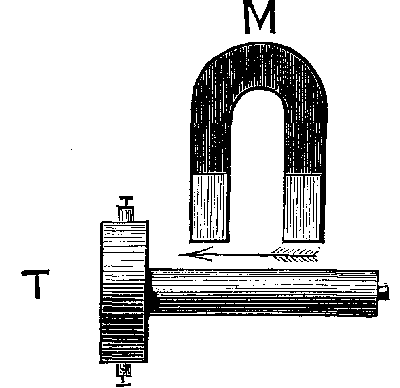
(10) B. G. - In reply to your inquiry as to Mr. Stroh's telephone experiment, we give the following, which we clip from theEnglish Mechanic: A singular experimental effect, of special interest just now from its possible bearing on the theory of the source of sound in the Bell telephone, has just been observed by Mr. Stroh, the well known mechanician. If a telephone, T, with the circuit of its coil left open, be held to the ear, and a powerful magnet, M, be moved gently up and down along the length of the magnet, as shown by the arrow, and at a distance of an inch or two from it, a faint breathing sound will be heard, the recurring pulses of sound keeping time with the up and down motion of the magnet. The sound may be aptly compared to the steady breathing of a child, and there is a striking resemblance between it and the microphonic sounds of gases diffusing through a porous septum as heard by Mr. Chandler Roberts. We understand that Professor Hughes is investigating the cause of this curious sound by help of the microphone.
(11) "Enterprise" asks: What part of its volume will iron expand in passing from a temperature of 60° to melting temperature? A. The cubical expansion of iron for each degree (C.) between 0° and 100° is 0.00003546 of its volume, its volume being 1. This ratio however, increases somewhat at higher temperatures, since the mean coefficient of expansion for each degree between 0° C. and 300° C. is 0.00004405. The question you ask has probably never been settled. You may form an approximation by the use of the above ratios, knowing the melting point of the iron.
(12) P. L. O. asks for a good chemistry for a beginner to study without a teacher. A. Fownes' "Chemistry;" Gorup-Besanez, "Inorganic, Organic and Physiological Chemistry."
(13) L. E. M. asks: What is the best method of keeping fine guns from rusting, and what oil should be used? A. For the outside, clear gum copal 1 part, oil of rosemary 1 part, absolute alcohol 3 parts. Clean and heat the metal and apply a flowing coat of the liquid by means of a camel's hair brush. Do not handle until the coat becomes dry and hard. For the inside of the barrel a trace of refined sperm oil is as good as anything, but an excess should be avoided.
(14) A. H. B. asks how much weight, falling 10 feet, will be required to produce one horse power for five hours? A. One horse power for 5 hours = 33,000 × 300 = 9,900,000 foot pounds - so that the weight required is 9,900,000 ÷ 10 = 990,000 lbs.
(15) A. D. R. asks: 1. In renewing a Leclanche battery, do the zincs have to be amalgamated? A. They are usually amalgamated. 2. Will two cells large size Leclanche battery give any light, using the simple lamp described in Supplement No. 162? A. No.
(16) H. L. J. writes: In a recent issue of the Scientific American you state that the floating of solid iron on melted iron is on the same principle as the floating of ice in water. I do not quite understand how it can be. Please explain. A. Solid iron, at an elevated temperature, floats upon molten iron for the same reason that ice floats upon molten ice-water - because it is specifically lighter. You will find the subject discussed at length in Tyndall's "Heat as a Mode of Motion."
(17) J. W. will find full directions for canning corn, etc., on p. 394 (4), vol. 39, Scientific American.
(18) "Amateur" writes: I wish to make some small bells that have a clear ring. What metal or metals can I use that I can melt easily? A. Use an alloy of tin and antimony. See Scientific American Supplement No. 17.
(19) H. - A nutritious mixed diet is unquestionably the best, care being taken to avoid an excess of meat.
(20) W. F. writes: I have made an engine, and would like to find out what size of boiler it will require. The cylinder has 2¼ inch bore and 3 inches stroke. A. It depends upon pressure and speed to be maintained; probably a vertical tubular boiler, 15 inches diameter, and 32 to 36 inches high, would suit you.
(21) R. G. (Salt Lake). - Please send full name.
(22) J. M. G. asks: If two persons each pull one hundred pounds on opposite ends of a rope, what will be the strain on the rope? A. The strain on the rope will be 100 lbs.
(23) W. M. M. asks: In laying off a mill stone in furrows, what draught is given? What amount of the space of a stone is given to furrows and what to grinding surface? A. There is considerable difference in the practice of various millers, and we would be glad to receive communications from those experienced in the art of dressing millstones.
Minerals, Etc. - Specimens have been received from the following correspondents, and examined, with the results stated:
S. (New Orleans.) - The powder consists of a mixture of zinc oxide and finely powdered resin. A quantitative analysis would be necessary to determine the proportions.
Any numbers of the Scientific American Supplement referred to in these columns may be had at this office. Price 10 cents each.
| COMMUNICATIONS RECEIVED. |
|---|
| Life Preserving Stone. By J. D. W. On Ventilation. By D. W. What is Mental Action? By N. K. Panama Railroad or Canal. By G. R. P. A Problem. By K. On the Gary Motor. By G. F. M. Magnetic Motor. By G. W. W., W. A. A., G. H. F. House Warming. By H. B. F. The Injector. By M. A. B. Columbus' Problem; Cure for Diphtheria; The Mullein Cure for Consumption. By R. W. L. A Visit to Tula. By L. R. On Vacuum in Pumps and the Atwood Machine. By P. J. D. On the Patent Bill. By R. |
[OFFICIAL.]
Continue to:


My Books

