


A New English Patent Pulley Block
Description
This section is from "Scientific American Vol.22, No. 1", by Munn & Co. Also available from Amazon: Scientific American Science Desk Reference.
A New English Patent Pulley Block
The following description of a new pulley block, which we take from the Ironmonger, does not give as clear an idea of the invention as could be desired, but it shows that invention in this field has not yet exhausted itself:
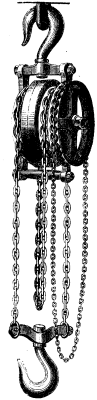
"The block is made on the differential principle. The lifting chain is passed over two sheaves, each of which is geared internally, the one having one or more teeth in excess of the other. Revolving around these internal teeth is a pinion, actuated by an eccentric, which is keyed on to a shaft passing through the center of the block, with a bearing at each end in the outside frame of the block. At one end of this shaft is a wheel with an endless hand chain passing over it; this gives the motion to the eccentric shaft. The teeth of the internal pinion are broad enough to gear into the teeth of both the sheaves, but as there is more teeth in one than in the other, they (the teeth) are not exactly opposite each other, and therefore will not admit the teeth of the revolving pinion without moving; but the tooth of the pinion, acting as a wedge, and entering with great power, pushes the one tooth forward and the other tooth back; and this continually occurring, a continual rotary motion is given to the sheaves, in opposite directions, with a power which is proportioned to the number of the teeth, the throw of eccentric, and the leverage gained by the diameter of the hand wheel. The lifting chain is passed over the one sheave, then down, and up over the other, the two ends being attached to a powerful cross bar, to which is connected the lifting hook. By this means the weight is distributed over the two sheaves and the two parts of the chain, increasing the safety and diminishing the friction of the block.
"The blocks are very simple in construction, and are not at all liable to get out of order; the construction being such that the weight cannot run down, though the men lifting let go the chain. They hang quite plumb when in action, and the men are able to stand clear away from under the load, as the hand-wheel chain can be worked at any angle."
Continue to:


My Books

