


A Novel French Hand Vise
Description
This section is from "Scientific American Vol.22, No. 1", by Munn & Co. Also available from Amazon: Scientific American Science Desk Reference.
A Novel French Hand Vise
In using ordinary hand vises several inconveniences are met with. For instance, if it is desired to work a piece of metal of a certain length, it must necessarily be presented obliquely on the side of the jaw of the vise, because of its screw, which is horizontal and forms a knob in the axis of the vise. The consequences are, first, that on tightening the nut of the horizontal screw vise the pressure is only exerted on the side, and greatly tries the vise itself while obtaining an irregular pressure; secondly, that as the piece to be worked is held obliquely, however skilled the workman may be, he always finds himself cramped in the execution of his work, particularly if of a delicate nature.
To avoid these inconveniences a Parisian mechanic has designed and lately patented in England the neat form of hand vise of which we annex illustrations, Fig. 1 being an elevation and Fig. 2 a longitudinal section. In these views, A, is a wooden or metal handle pierced throughout its length; this handle of metal may be made in one piece, with the nut, and the conical ferrule. B is the ring or ferrule of the handle; and C are the jaws of the vise worked by the adjusting screw, D, and the springs, r r. E is a conical ferrule or shoulder, fixed or movable, and serving to open or close the jaws of the vise accordingly as the handle is turned right or left; this conical shoulder is protected from wear by a tempered steel washer, v. G is a nut with collar carrying the conical ferrule or shoulder, E, and the steel washer, v, while H H are the joints of the jaws of the vise held by a screw, I, which serves as a support to the adjusting screw.
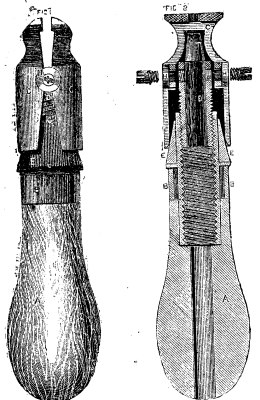
FIG. 1. FIG. 2.
This hand vise may be applied to a number of uses, and among others it may be readily converted into a haft or handle for any kind of tailed or shanked tool, such as files, wrenches, olive bits, chisels, or screwdrivers, and may also serve as pincers or nippers. It is of very simple construction.
Continue to:


My Books

