


Russ' Improved Wood Molding Machine
Description
This section is from "Scientific American Vol.22, No. 1", by Munn & Co. Also available from Amazon: Scientific American Science Desk Reference.
Russ' Improved Wood Molding Machine
A comprehensive description of this excellent machine was given upon page 230, Vol. XVIII., of the SCIENTIFIC AMERICAN. We now present our readers with an engraving of it and a summary of its important features, which doubtless render it equal if not superior to any machine of the kind in market. The frame in which the feed rollers are arranged is so hung to the frame-work of the molding machine, that it can be raised or lowered at pleasure, in order to properly adjust the feed rollers for action upon the "stuff," and it is also so constructed as to permit the feed rollers to yield in case of variations in the thickness of the "stuff" passing under them. The spindle of the side cutter-heads is hung in a vertical frame arranged to be moved up and down, and laterally, to adjust the cutter-head for action, and is provided at its upper end with a box or bearing, whereby the bearing of the box is always kept upon the spindle instead of at different points of the same as in other machines, and this without interfering with the adjustability of the side cutter-head. Thus uneven wear is avoided.
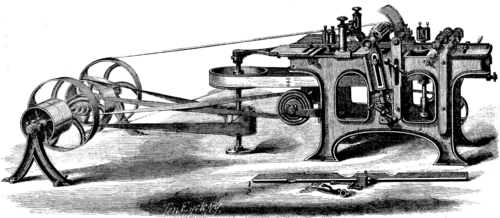
RUSS' MONITOR MOLDING MACHINE.
The bed of the machine is formed with a series of slots or openings provided with bridge bars so that the cutters may act upon the edges of the stuff without danger of injury from striking the bed. The presser shoe is also made adjustable for different thicknesses of the "stuff" and self-yielding to variations in thickness, by a peculiar method of hanging the bar, which carries the presser shoe, to the framework of the machine.
The clamp which holds the press block which acts upon the "stuff" after it has passed through the cutter, is of novel construction, and the spindle of the side cutter-heads is so arranged in connection with a loose pulley and the pulley-drums, that both cutter-heads are driven by one belt and in the same direction.
The bed plate is provided with springs through which the side cutter-heads are arranged, to move laterally or transversely with a bridge-plate or plates, susceptible of adjustment independent of the cutter-heads, whereby an adjustable support to the "stuff" is given as it passes over the line of the openings in the bed.
Most machines have weighted pressure feed, but this having steel springs adjustable by a screw and hand wheel, a heavy or light pressure can be applied according to the work done or size of molding. The cutter-heads are square and slotted so that any style of molding can be stuck by putting cutters on all sides of the head, thus equalizing the cost and lessening the power. The pressure shoe is arranged to hold the "stuff" at the very point of contact with the cutters, and, as we have shown, is readily adjusted to a long or short cutter, so that a small molding can be made as smooth as a large one, and so as not to require any finishing with sandpaper or a hand tool.
The machine has also a bevel track very useful for picture frame molding, and a patent cap of great value for the cutters, and readily applied to any slotted head or common head. The wrenches that go with the machine, and the common malleable iron caps for the top cylinder, are shown in detail. These machines are now running in Worcester, Boston, and Fitchburg, Mass.; Chicago, Ill.: Philadelphia, Pa.; Brattleboro, Vt.; Whitesboro, N. Y.; Charleston, S. C., and other places, and, it is claimed, are capable of doing better work and more of it than any machine now in use.
This machine is covered by several patents taken through the Scientific American Patent Agency. It is manufactured by R. Ball & Co., of Worcester, Mass, to whom write for further information.
Continue to:


My Books

