


A New Form Of Gas Washer
Description
This section is from "Scientific American Supplement". Also available from Amazon: Scientific American Reference Book.
A New Form Of Gas Washer
By A. BANDSEPT, of Brussels.
The washer is an appliance intended to condense and clean gas, which, on leaving the hydraulic main, holds in suspension a great many properties that are injurious to its illuminating power, and cannot, if retained, be turned to profitable account. This cleaning process is not difficult to carry out effectually; and most of the appliances invented for the purpose would be highly efficacious if they did not in other respects present certain very serious inconveniences. The passage of the gas through a column of cold water is, of course, sufficient to condense it, and clear it of these injurious properties; but this operation has for its immediate effect the presentation of an obstacle to the flow of the gas, and consequently augmentation of pressure in the retorts. In order to obviate this inconvenience (which exists notwithstanding the use of the best washers), exhausters are employed to draw the gas from the retorts and force it into the washers. There is, however, another inconvenience which can only be remedied by the use of a second exhauster, viz., the loss of pressure after the passage of the gas through the washer--a loss resulting from the obstacle presented by this appliance to the steady flow of the gas.
Now as, in the course of its passage through the remaining apparatus, on its way to the holder, the gas will have to suffer a considerable loss of pressure, it is of the greatest importance that the washer should deprive it of as little as possible. It will be obvious, therefore, that a washer which fulfills the best conditions as far as regards the cleaning of the gas will be absolutely perfect if it does not present any impediment to its flow. Such an appliance is that which is shown in the illustration on next page. Its object is, while allowing for the washing being as vigorous and as long-continued as may be desired, to draw the gas out of the retorts, and, having cleansed it perfectly from its deleterious properties, to force it onward. The apparatus consequently supplies the place of the exhauster and the scrubber.
The new washer consists of a rectangular box of cast iron, having a half-cylindrical cover, in the upper part of which is fixed a pipe to carry off the gas. In the box there is placed horizontally a turbine, the hollow axis of which serves for the conveyance of the gas into the vessel. For this purpose the axis is perforated with a number of small holes, some of which are tapped, so as to allow of there being screwed on to the axis, and perpendicularly thereto, a series of brooms made of dog grass, and having their handles threaded for the purpose. These brooms are arranged in such a way as not to encounter too great resistance from contact with the water contained in the vessel, and so that the water cast up by them shall not be all thrown in the same direction. To obviate these inconveniences they are fixed obliquely to the axis of the central pipe, and are differently arranged in regard to each other. A more symmetrical disposition of them could, however, be adopted by placing them zigzag, or in such a way as to form two helices, one of which would move in a particular direction, and the other in a different way.
The central pipe, furnished with its brooms, being set in motion by means of a pulley fixed upon its axis (which also carries a flywheel), the gas, drawn in at the center, and escaping by the holes made in the pipe, is forced to the circumference of the vessel, where it passes out.
The effect of this washer is first, to break up the current of gas, and then force it violently into the water; at the same time sending into it the spray of water thrown up by the brooms. This double operation is constantly going on, so that the gas, having been saturated by the transfusion into it of a vigorous shower of water (into the bulk of which it is subsequently immersed), is forced, on leaving the water, to again undergo similar treatment. The same quantity of gas is therefore several times submitted to the washing process, till at length it finds its way to the outlet, and makes its escape. The extent to which the washing of the gas is carried is, consequently, only limited by the speed of the apparatus, or rather by the ratio of the speed to the initial pressure of the gas. This limit being determined, the operation may be continued indefinitely, by making the gas pass into several washers in succession. There is, therefore, no reason why the gas should not, after undergoing this treatment, be absolutely freed of all those properties which are susceptible of removal by water. In fact, all that is requisite is to increase the dimensions of the vessel, so as to compel the gas to remain longer therein, and thus cause it to undergo more frequently the operation of washing.
These dimensions being fixed within reasonable limits, if the gas is not sufficiently washed, the speed of the apparatus may be increased; and the degree of washing will be thereby augmented. If this does not suffice, the number of turbines may be increased, and the gas passed from one to the other until the gas is perfectly clean. This series of operations would, however, with any kind of washer, result in thoroughly cleansing the gas. The only thing that makes such a process practically impossible is the very considerable or it may be even total loss of pressure which it entails. By the new system, the loss of pressure is nil, inasmuch as each turbine becomes in reality an exhauster. The gas, entering the washer at the axis, is drawn to the circumference by the rotatory motion of the brooms, which thus form a ventilator. It follows, therefore, that on leaving the vessel the gas will have a greater pressure than it had on entering it; and this increase of pressure may be augmented to any desired extent by altering the speed of rotation of the axis, precisely as in the case of an exhauster.
Forcing the gas violently into water, and at the same time dividing the current, is evidently the most simple, rational, and efficient method of washing, especially when this operation is effected by brooms fixed on a shaft and rotated with great speed. Therefore, if there had not been this loss of pressure to deal with--a fatal consequence of every violent operation--the question of perfect washing would probably have been solved long ago. The invention which I have now submitted consists of an arrangement which enables all loss of pressure to be avoided, inasmuch as it furnishes the apparatus with the greatest number of valuable qualities, whether regarded from the point of view of washing or that of condensation.
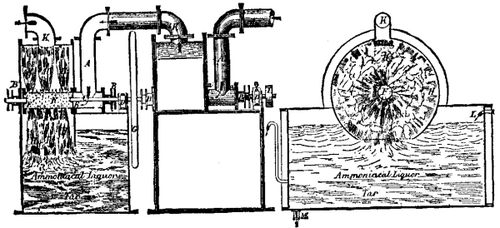
Longitudinal Section. Elevation. Transverse Section.
Referring to the illustration, the gas enters the washer by the pipe, A, which terminates in the form of a [Symbol: inverted T]. One end (a) of this pipe is bolted to the center of one of the sides of the cylindrical portion of the case, in which there is a hole of similar diameter to the pipe; the other (a') being formed by the face-plate of a stuffing-box, B, through which passes the central shaft, C, supported by the plummer-block, D, as shown. This shaft has upon its opposite end a plate perforated with holes, E, which is fixed upon the flange of a horizontal pipe, F. This pipe is closed at the other end by means of a plate, E', furnished with a spindle, supported by a stuffing-box, B', and carrying a fly-wheel, G. The central pipe, F, is perforated with a number of small holes. The gas entering by the pipe, A, makes its way into the central pipe through the openings in the plate, E, and passes into the cylindrical case through the small holes in the central pipe, which carries the brooms, H. These are caused to rotate rapidly by means of the pulley, I; and thus a constant shower of water is projected into the cylindrical case.
When the gas has been several times subjected to the washing process, it passes off by the pipe, K. Fresh cold water is supplied to the vessel by the pipe, L; and M is the outlet for the tar.--Journal of Gas Lighting.
Continue to:


My Books

