


Hughes' New Magnetic Balance
Description
This section is from "Scientific American Supplement". Also available from Amazon: Scientific American Reference Book.
Hughes' New Magnetic Balance
A new magnetic balance has been described before the Royal Society by Prof. D. E. Hughes, F.R.S., which he has devised in the course of carrying out his researches on the differences between different kinds of iron and steel. The instrument is thus described in the Proceedings of the Royal Society:
"It consists of a delicate silk-fiber-suspended magnetic needle, 5 cm. in length, its pointer resting near an index having a single fine black line or mark for its zero, the movement of the needle on the other side of zero being limited to 5 mm. by means of two ivory stops or projections.
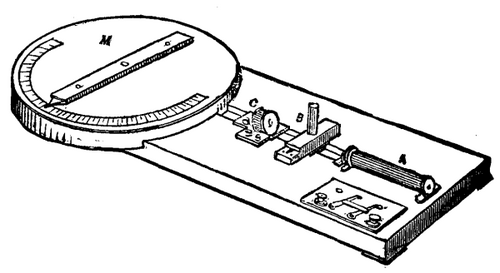
When the north end of the needle and its index zero are north, the needle rests at its index zero, but the slightest external influence, such as a piece of iron 1 mm. in diameter 10 cm. distant, deflects the needle to the right or left according to the polarity of its magnetism, and with a force proportional to its power. If we place on the opposite side of the needle at the same distance a wire possessing similar polarity and force, the two are equal, and the needle returns to zero; and if we know the magnetic value required to produce a balance, we know the value of both. In order to balance any wire or piece of iron placed in a position east and west, a magnetic compensator is used, consisting of a powerful bar magnet free to revolve upon a central pivot placed at a distance of 30 or more cm., so as to be able to obtain delicate observations. This turns upon an index, the degrees of which are marked for equal degrees of magnetic action upon the needle. A coil of insulated wire, through which a feeble electric current is passing, magnetizes the piece of iron under observation, but, as the coil itself would act upon the needle, this is balanced by an equal and opposing coil on the opposite side, and we are thus enabled to observe the magnetism due to the iron alone.
A reversing key, resistance coils, and a Daniell cell are required."
The general design of the instrument, as shown in a somewhat crude form when first exhibited, is given in the figure, where A is the magnetizing coil within which the sample of iron or steel wire to be tested is placed, B the suspended needle, C the compensating coil, and M the magnet used as a compensator, having a scale beneath it divided into quarter degrees.
The idea of employing a magnet as compensator in a magnetic balance is not new, this disposition having been used by Prof. Von Feilitzsch in 1856 in his researches on the magnetizing influence of the current. In Von Feilitzsch's balance, however, the compensating magnet was placed end on to the needle, and its directive action was diminished at will, not by turning it round on its center, but by shifting it to a greater distance along a linear scale below it. The form now given by Hughes to the balance is one of so great compactness and convenience that it will probably prove a most acceptable addition to the resources of the physical laboratory.--Nature.
Continue to:


My Books

