


Instantaneous Photography. Part 2
Description
This section is from "Scientific American Supplement". Also available from Amazon: Scientific American Reference Book.
Instantaneous Photography. Part 2
The luminous rays, in fact, form in the objective a double truncated cone whose upper base is equal to the diaphragm, and the lower one to the diameter of the lenses. If the aperture be equal to any diameter whatever of one of the cones, the result will be the same; but, for the same period of exposure, it will evidently prove advantageous to approach the diaphragm. The ratio of the apertures that give the same results at the optical center or behind the objective is as that of the diaphragm employed to that of the back lens. If the diaphragm is one centimeter and the lenses four centimeters, an aperture of one centimeter in one case and of four in the other will give the same result.
We shall see further along that it is advantageous to employ apertures equal to several times the diameter of the diaphragm or lens. Now, from what we have just said, an aperture, equal for example to four times the diaphragm, will be only 4 centimeters, while the corresponding aperture behind the lens must be 16. The dimensions of the first will be practical, and those of the second will give too cumbersome and too fragile an apparatus. But why must the aperture be larger than the diaphragm employed? This is what we are going to demonstrate. Let us make the aperture equal to the diameter of the objective, and see what occurs at the different periods of the exposure. For the sake of clearness, we shall suppose the velocity uniform.
It is evident, a priori, that a perfect apparatus will be the one that will allow the light to act during the entire exposure with a maximum of intensity. Is it thus, when the aperture is equal to the diameter of the objective? Evidently not. Let us consult Fig. 2. We here see the shutter progressively uncovering the objective. The light will increase from A to C up to the moment when the objective is entirely uncovered, and will then immediately decrease up to B. The objective has operated with a maximum of light for only a short time. We are far from the ideal result in which the maximum of light, CD, should exist during the entire exposure, and form the upper plane precisely equal to AB.
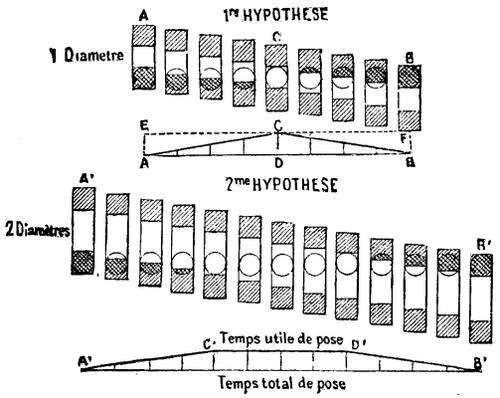
Fig. 2.
If we cannot obtain such a result in practice, we must nevertheless aproximate to it. We shall do so by increasing the shutter. Up to C' the apparatus will operate as before, but from C' to D' the aperture will be complete, and from D' to B' will decrease as has been said.
Let us give A'B' the same value as AB, that is to say, let us increase the velocity in the second case in order that the time of exposure shall be the same; we shall at once see that in the first case the object will be completely uncovered for only a very short time, while in the second the exposure will be perfect for a very appreciable period.
The time of exposure which is absolutely active, we propose to call effective time of exposure in contradistinction to the total time of the same. The more we increase the value of C'D', that is to say, that of the effective time, the more the ratio, C'D'/A'B', will approximate to unity, and the nearer we shall reach perfection. The correlative of such elongation of the aperture is an increase in velocity which will always bring the total exposure to the same figure, whatever be the aperture employed.
If the aperture be equal to two diameters, the effective time will be equal to half the time of the total exposure; and if it is equal to three diameters, the exposure will be good during 2/3 of the total time. This amounts to saying that the effective time of exposure is equal to n times the diameter--1, the velocity being supposed always uniform. If we place the shutter within the objective, it is the diameter of the diaphragm that it will be necessary to say. The effective time will be equal then to n diaphragm--1.
From what precedes it results that in no case should the aperture be inferior to the diaphragm, since the former would otherwise absolutely suppress the effective time in giving a lower plane corresponding to an insufficient quantity of light. Moreover, an aperature of this kind would prove injurious to the quality of the image by successively uncovering rays which do not form their image identically at the same point. We are now, then, in presence of results that are absolutely positive, and they are as follows:
1. The guillotine shutter should be placed in the interior of the objective and as near as possible to optical center, that is to say, behind the diaphragm, since the latter is precisely in the optical center.
2. The aperture should be as wide as possible.
3. The velocity should be as great as possible.
In practice, an aperture from 4 to 5 times the diameter of diaphragm employed will be more than sufficient, since we shall have, according to circumstances, ¾ or 4/5 of the effective time. Moreover, whatever be the time of exposure, this ratio once established will be invariable, and the apparatus will always operate identically.
A shutter combining these qualities will not yet be perfect. It is necessary, according to the time and the light, that the time of exposure shall be capable of being varied. In a word, it is necessary that the apparatus shall be graduated and permit of taking views more or less quickly. The different velocities might be given to the shutter by means of weights, rubber, or springs. The latter seem to be preferable, since they permit in the first place of operating out of the vertical; moreover, they are less fragile, and, through different tensions, they permit of these graduations that we consider as indispensable. For the current needs of practice 1/100 of a second is a limit that seems to us sufficient as a maximum of rapidity. In order to know the time of exposure obtained we employ the following method, which permits of graduating an apparatus rapidly and with extreme precision:
Continue to:


My Books

