


New Accumulators
Description
This section is from "Scientific American Supplement". Also available from Amazon: Scientific American Reference Book.
New Accumulators

FIG. 1. - ARNOULD & TAMINE'S ACCUMULATOR.
In Messrs. Arnould and Tamine's accumulators, shown in Fig. 1, the formation is effected directly by the current, as in the Planté pile, but the plates are formed of wires connected horizontally at their extremities by soldering. These plates are held apart either by setting them into paraffined wooden grooves at the ends of the trough or by interposing between them pieces of paraffined wood.

FIG. 2. - BARRIER & TOURVIELLE'S ELECTRODOCK.
In Messrs. Barrier and Tourville's Electrodock (Fig. 2) the plates are formed of concentric leaden tubes fixed into a wooden cover. These tubes are threaded internally and externally, and the grooves thus produced are filled with a peculiar cement composed of litharge, powdered charcoal, and permanganate of potash, triturated together, sifted, and then mixed with glucose or sugar sirup so as to make a paste of them. This mixture forms a cement that is very adhesive after, as well as before, the electrolytic action.

FIG. 3. - KORNBLUH'S ACCUMULATOR.
In Kornbluh's accumulators the plates consist of ribbed leaden gratings between which is compressed red lead prepared in a peculiar manner, and constituting, 48 hours after formation, a compact mass with the lead. The tangs of the plates are widened so as to touch one another while leaving a proper distance between the plates themselves, and are hollowed out for the reception of a rod provided at its extremities with a winged nut and jam nut for passing them up close to one another. The plates, properly so called, are held apart by rubber bauds. The glass vessels are placed in osier baskets. - La Lumiere Electrique.
Industrial Model Of The Reynier Zinc Accumulator
The three models of a secondary battery that I recently made known to the readers of this journal have been the object of continuous experiment. Conformably to the provisions of theory, the zinc accumulator has shown itself practically superior to the two others, and I have therefore chosen this type for getting up an industrial model, which is shown in the annexed cut. The accumulator contains four Planté positives, having a wide surface, and three negatives constructed of smooth sheets of lead covered with zinc by the electrolysis of the acidulated solution of zinc sulphate in which the couple is immersed. Accidental contact with the interior of the pile is prevented by glass tubes fixed to the negatives by means of leaden bands. The seven electrodes are carried by as many distinct crosspieces of paraffined wood, which rest upon the edges of the trough and hold the plates at a certain distance from the bottom. These various crosspieces, which touch one another, take the place of a cover. Each plate is provided with a terminal. The four positive terminals are all on the same side, and the three negatives are on the opposite side. Two brass rods ending in a wire-clamp connect the respective terminals of the same name.
The trough consists of two oblong wooden receptacles, one within the other, and having a play of several millimeters. This space is lined with a tight, elastic, insulating cement having tar for a base.
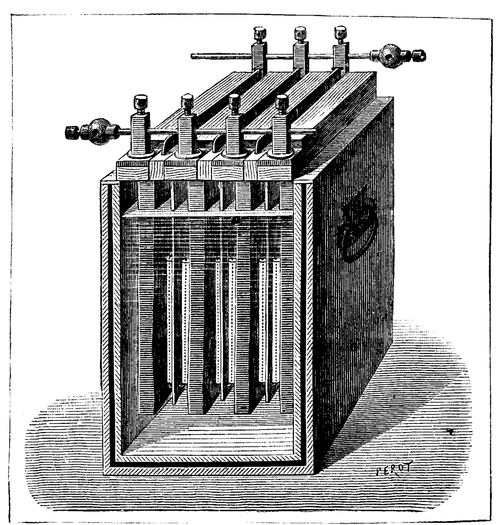
REYNIER'S ZINC ACCUMULATOR. (One-fifth actual size.)
The careful insulation of the trough and all parts of the apparatus, and the purity of the metal and its amalgamation, reduce the local attack of the zinc to almost nothing. So the coefficient of restitution is now comparable with that of accumulators of the Planté type.
The following are the principal numerical data of the new zinc accumulator.
| PHYSICAL DATA. | ||
|---|---|---|
| E. | Electromotive force. | 2.36 volts. |
| R. | Mean resistance. | 0.02 ohm. |
| I. | Normal intensity of the discharge current. | 25 amperes. |
| i. | Intensity of the charge current. | 5 to 10 amperes. |
| Q. | Capacity of accumulation after 200 hours' formation. | 550,000 couples. |
| DATA CONCERNING CONSTRUCTION. | |
|---|---|
| Efficient surface of the 4 positive electrodes. | 200 square dec. |
| Efficient surface of the 3 negative electrodes. | 15 square dec. |
| Weight of the positive electrodes. | 8.2 kilogrammes. |
| Weight of the negative electrodes. | 1.4 kilogrammes. |
| Weight of the trough. | 2.7 kilogrammes. |
| Weight of the liquid. | 4.4 kilogrammes. |
| Weight of the attachments. | 0.46 kilogrammes. |
| Weight, total. | 17.16 kilogrammes. |
The total electric work stored up is 130,000 kilogrammeters, or 7,600 kilogrammeters per kilogramme of accumulator. Theory indicates that a zinc accumulator might store up as much as 15,600 kilogrammeters per kilogramme. If the present model gives half less, it is because I have purposely exaggerated the solidity of the trough and the mass of the electrodes.
It should be remarked that this capacity of 7,600 kilogrammeters per kilogramme is much greater than that of any other accumulator constructed in France. The new model possesses, then, despite the size of the positives and the box, a relative lightness that will permit it to take a place upon electric locomotives as well as in fixed installations.
Independently of their use as accumulators, secondary zinc batteries may be utilized as regulating voltameters in lighting by incandescence, for deadening piston strokes, attenuating the irregularities in speed, and covering accidental stoppages. - E. Reynier, in La Nature.
Continue to:


My Books

