


Project For A Roadstead At Havre. Continued
Description
This section is from "Scientific American Supplement". Also available from Amazon: Scientific American Reference Book.
Project For A Roadstead At Havre. Continued
In Bouniceau's "Marine Constructions" we find a curious figure, a sort of open framework of clumsy form anchored in a singular manner, and surmounted by rooms for watchmen, semaphores, posts for the shipwrecked, etc. It is, indeed, the most complicated and most impracticable type that could be imagined.
Mr. Lewis' model, which was exhibited last year at the International Fisheries Exhibition, was, on the contrary, one of the simplest. It consisted of a strong piece of wood of nearly triangular section, the sharpest angle of which, being turned oceanward, was designed to cut the waves and cause them to break over it (Fig. 2). If, by favor of divine Providence, this breakwater, which presents absolutely plane surfaces to the shock and pressure of the waves, is not broken to fragments in the first tempest, it will certainly acquit itself of the role for which the inventor destined it. When we have a system of resistance to the sea, anchored and facing a certain direction, and consequently not being able to revolve around its axis as vessels do, care must be taken not to give it entire surfaces.
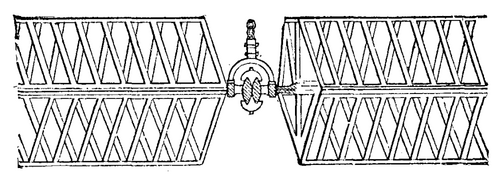
FIG. 4. - FROIDEVILLE'S BREAKWATER. - MODE OF JOINING THE PARTS.
Mr. Froideville's breakwater consists of a framework 25 meters in length, and 9 in height and width, and having the form of an irregular 5-sided prism (Fig. 3). The smallest side of the prism is designed to serve as a flat keel. The axis is formed of a metallic float, from whence start radii that form the skeleton of the framework, and that are designed for connecting the center with five long spruce beams that form the angles of the prism. To these beams are affixed the cross pieces that form the openwork sides. Five long pieces of wood parallel with the beams, but not so strong as they, protect the cross pieces and secure them against breakage in the middle. All the angles of the breakwater and all points of juncture of the pieces are protected with iron, and it is in order to counterbalance the weight of all this iron that the central float is used. Parallel with this first breakwater, there are two other and smaller ones, which are designed for reducing the effect of rolling as much as possible.
Reduced to a single float, the breakwater might remain under the waves too long, but, owing to the two others, it rights itself, warps around, and always presents the spur of its sharp roof to the wave.
In order to prevent the breakwaters from clashing against each other, they are united end to end in a very simple and ingenious manner. From each of them there starts a deeply inserted iron bar which terminates in a journal that permits the breakwater to oscillate. Between these two bars there is a sort of swivel, whose pieces, in playing upon one another, give the breakwaters elasticity, while always holding them apart (Fig. 4). From each side of the swivel start the branches of a stirrup iron to which the anchorage chain is attached. This latter is of steel, without solderings, and it is so perfectly constructed that no breakage need be feared. To the other extremity of the chain is attached an anchor having two flukes, which both engage with the bottom.
Mr. Froideville proposes to set up two lines of these breakwaters, for a length of about 7½ kilometers, starting at the north from Cape Heve, taking in depths of 15 meters (the best that are found in the Little Roadstead), passing in front of the Eclat shoal and the heights, and ending opposite the entrance of the present port.
The first row is designed for breaking the force of the waves, and the second for lending its aid in times of high tempests, and stopping the surge that has escaped from the first.
The extreme simplicity of this project has permitted its promoter to affirm that in a few months, and with nine millions, he can inclose the Havre roadstead.
The Little Roadstead, being thenceforward protected, will become an excellent port of refuge in bad weather. In addition, a system of lighters, or, better, a few floats connected with the shore and forming a rock, will permit vessels to take on their cargoes with great rapidity.
Mr. Froideville's project presents the further advantage of rendering it easier to put the port of Havre quickly in defense. A certain number of floating batteries, anchored behind the breakwaters and protecting the advances of torpedo boats by means of their firing, would make a formidable defense. Not having to perform any evolutions, they might without danger be invested with armor plate thicker than that of ordinary ironclads. In order to complete the system, there might be erected upon the Eclat shoal an ironclad fort like that which defends the entrance of Portsmouth.
An English chronicler of the fourteenth century, in speaking of his country, places it above all others, and declares that men are handsomer, whiter, and purer blooded there than elsewhere, and he says that this is so "because it is so." We would not like to imitate his naive reasoning, and yet, for defending the very original system proposed by Mr. Froideville, we have only our conviction, which we share, moreover, with a large number of sea-faring men and engineers. Mathematics are powerless to predict to us with accuracy the manner in which the floating breakwaters will behave, but experiment remains. Let the promoter of the project, then, be given authority to inclose a few hundred meters, and if, as we suppose, the breakwaters shall remain immovable in a northwester, a maritime revolution will have been brought about. - La Nature.
Continue to:


My Books

