


Steel Chains Without Welding
Description
This section is from "Scientific American Supplement". Also available from Amazon: Scientific American Reference Book.
Steel Chains Without Welding
We take the following description, together with the illustrations, of a method and machine for making steel chain without welding, from our valued contemporary, Le Genie Civil, of Paris:
When we regard an ordinary oval-linked chain endwise, it presents itself in the form of a metal cross, and it was this that gave the cue to M. Oury, of the Government Arsenals, to construct chain without welding. By a series of matrices and punches, etc., he contrives, with small loss of metal, to model a chain out of cross-shaped steel bar.
Steel is the better material for such usage, from its homogeneity, both as to composition and strength.
Referring to the plate below, Figs. 1 to 10 explain the successive steps from the bar to the finished chain.
Fig. 1 shows in plan and section the steel bar, whose length may be some 40 feet, and which would make a chain say 50 feet long. The shape of the bar presents no difficulties in the way of rolling.
Figs. 2 and 3 give, in side elevations of the two faces and sections, the first rough form of the links. These first begin to take the exterior shape with the rounding of the angles.
The operations following, represented by Figs. 4 and 5, is the piercing of the center of the links, which can later be furnished with a stay for such chains as require special strength. The point now is to detach the links, which is accomplished by oblique piercings, as shown in Fig. 6. In the operation represented by Fig. 7, the oval shape is imparted to the link, and the operation finishes as shown in Fig. 8.
Actually, the links are circular and separate. This separation is retarded as much as possible, for it is plain that it is easier to operate a rigid bar than a chain, above all when the operation necessitates its being pushed forward.
By means of a good system of heating, analogous to that employed on the large parts entering into ship construction, it is hoped to perform a major part of the operations, of which we have given but an idea, at a single heat.
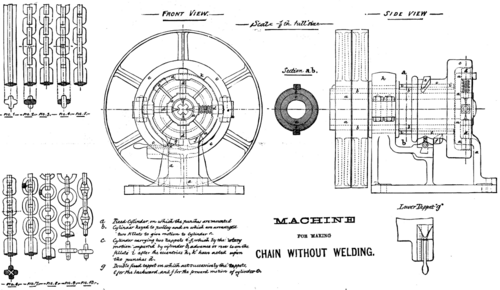
MACHINE FOR MAKING CHAIN WITHOUT WELDING.
These operations require work on both faces alternately--this presents no difficulties; but what appears to us most difficult to realize is continuous work, the bar passing through several machines which successively impress upon it the steps of progress toward the finished chain. If the machines are end on to each other in a direct line, there will necessarily be a fixed place for each tool; the rough cut chain must accurately reach the point where another tool is ready to continue the modeling. This appears to us practically impossible, the more so as the elongation which the bar takes at each stamp varies with its initial diameter.
What is more admissible is that with one heat and in the same machine an operation could be performed on the two faces perpendicularly. The bar could then be taken from one furnace and put in another immediately, to pass at once to another machine to again undergo the operations following. The work could then be done rapidly, submitting the bar to several heats.
A few words on the tools as they exist.
The most important principle to note, and on which the different machines employed are designed, is this: The punches or matrices acting on the chain at its different points of progress are put in motion by spiral springs worked by means of tappets or cams distributed over the circumference of a cylinder, having a rotary movement imparted to it by pulleys and belts.
The figures on our plate show with sufficient clearness the working of one of these machines. It will be seen that the bar traverses through and through the machine for stamping, and that it can be disengaged for a reheating before passing to subsequent operations.
The bog peat of Mexico is now being used on a considerable scale as fuel for locomotives, stationary engines, smelting purposes, smiths' fires, and househould use. The peat is mixed with a proper proportion of bitumen, and is said not only to burn freely, and without smoke in much quantity, but to give a higher dynamic equivalent of heat than the same amount of wood.
Continue to:


My Books

