


The Cay Monument At Uxmal. Discovered By Dr. Le Plongeon On June 1, 1881
Description
This section is from "Scientific American Supplement". Also available from Amazon: Scientific American Reference Book.
The Cay Monument At Uxmal. Discovered By Dr. Le Plongeon On June 1, 1881
In 1881, we went for the second time to the ancient ruined city of Uxmal, Yucatan, and lived there four months, making moulds of every ornament and inscription, from which moulds perfect facsimiles of those grand old palaces can be produced in plaster, and placed in any exposition or museum.
During our stay there, on June 1, Dr. Le Plongeon had the great satisfaction of discovering a monument, a splendid work of art in all its pristine beauty, fresh as when the artist put the finishing touch to it, without blemish, unharmed by time, and not even looked upon by man since it was concealed, ages ago, where Dr. Le Plongeon discovered it through his interpretations of certain inscriptions. It was probably hidden to save it from destruction, between the sixth and seventh centuries of the Christian era, when the Naualts invaded and overran the country, demolishing many art treasures of the Mayas.
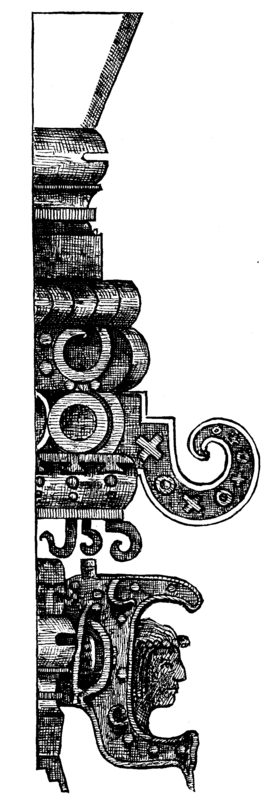
The monument represents a mastodon head, with various ornaments above and below it, the whole measuring 3.50 m. (11 feet 4½ inches) in height, and in width 1.25 m. (4 feet 1 inch). Above the mastodon head there is a chain, nearly 10 inches deep; the stones forming the links are sculptured and fitted into each other just like the rattles of a rattlesnake; and yet higher another row of stones resembling knots. The uppermost part is composed of stones that incline outward from above; they are flat, measuring 0.55 by 0.45 centimeters (21 inches by 17 inches), and are covered with various signs pertaining to certain mysteries.
On the sides of the mastodon's trunk are these signs
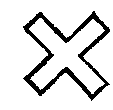
an "x"
and a
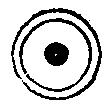
"circle with a dot in the middle"
which read Tza, and means that which is necessary. Beneath the trunk and the upper jaw is what is meant to represent the distended jaws of a serpent; on it is inscribed the family name, | | | |, Can, the mouth (chi) of the serpent giving the second part of the name. Canchi means "serpent's mouth," and was the name of the royal family that ruled over the Mayas when their civilization was at its height.
Within the serpent's jaws is the greatest gem of American sculpture yet discovered. It is a head and throat, sculptured in the round, of Cay Canchi, the high priest and elder brother of the warrior Chaacmol, whose statue we exhumed from 8 meters below the soil in Chichen Itza, during the year 1876; which statue was afterward robbed from us by the Mexican government, and is now in the museum at Mexico city. The stone out of which the beautiful head is cut is not polished, but wrought so finely as to almost imitate the texture of the skin. It is decidedly a good looking face. The nostrils are most delicately chiseled, and the cartilage pierced; the eyes are open, and clearly marked. On the right cheek is his totem, a fish traced in exceedingly small cross bars. The forehead is well formed, not retreating, and incircled by a diadem composed of small disks, from the front of which projects a perfect fish's head. The hair is short in front, and hangs like a fringe on the upper part of the forehead, but is longer at the sides, hanging in straight locks.
On the wall against which this monument is built, feathers are sculptured, forming a canopy. Such a superb chef d'oeuvre proves beyond doubt that the Maya artists were in no way inferior to those of Assyria and Egypt.
Having been so unjustly deprived of Chaacmol without any remuneration for our time, labor, and expenditure, we decided to save the Cay monument from destruction at any cost, for should any ignorant persons attempt to move it, they would break it in so doing; so, after making a mould of it, we guarded it most securely, as we considered best, afterward inclosing it with planks, then built it up and left it as we had found it.
Sr. Don Romero Ancona, then Governor of Yucatan, was very much provoked because we would not reveal the whereabouts of our find, but gained nothing by it, and the beautiful monument is still safe.
ALICE D. LE PLONGEON.
Rolled gold is made by casting an ingot of brass, and while this is still hot pouring upon it a thin layer of gold alloy. The ingot when cold is forced between steel rollers until a long, thin ribbon is produced, of which the proportion of gold and brass is the same as of the ingot. The percentage of gold is reduced as low as two and three per cent. This rolled gold is used in making cheap bracelets and watch chains. It wears from one to ten years.
Continue to:


My Books

