


The Dodder
Description
This section is from "Scientific American Supplement". Also available from Amazon: Scientific American Reference Book.
The Dodder
The genus Cuscuta contains quite a number of species which go under the common name of dodder, and which have the peculiarily of living as parasites upon other plants. Their habits are unfortunately too well known to cultivators, who justly dread their incursions among cultivated plants like flax, hops, etc.
All parasitic plants, or at least the majority of them, have one character in common which distinguishes them at first sight. In many cases green matter is wanting in their tissues or is hidden by a livid tint that strikes the observer. Such are the Orobanchaccae, or "broomropes," and the tropical Balanophoraceae. Nevertheless, other parasites, such as the mistletoe, have perfectly green leaves.
However this may be, the naturalist's attention is attracted every time he finds a plant deprived of chlorophyl, and one in which the leaves seem to be wanting, as in the dodder that occupies us. In fact, as the majority of parasites take their nourishment at the expense of the plants upon which they fasten themselves, they have no need, as a general thing, of elaborating through their foliar organs the materials that their hosts derive from the air; in a word, they do not breathe actively like the latter, since they find the elements of their nutrition already prepared in the sap of their nurses. The dodders, then, are essentially parasites, and their apparent simplicity gives them a very peculiar aspect. Their leaves are wholly wanting, or are indicated by small, imperceptible scales, and their organs of vegetation are reduced to a stem and filiform branches that have obtained for them the names of Cheveux de Venus (Venus' Hair) and Cheveux du Diable (devil's hair) in French, and gold thread in English. Because of their destructive nature they have likewise been called by the unpoetic name of hellweed; and, for the reason that they embrace their host plants so closely, they have been called love weed and love vine.
When a seed of Cuscuta, germinates, no cotyledons are to be distinguished. This peculiarity, however, the plant has in common with other parasites, and even with some plants, such as orchids, that vegetate normally. The radicle of the dodder fixes itself in the earth, and the little stem rises as in other dicotyledons; but soon (for the plantlet could not live long thus) this stem, which is as slender as a thread, seeks support upon some neighboring plant, and produces upon its surfaces of contact one or more little protuberances that shortly afterward adhere firmly to the support and take on the appearance and functions of cupping glasses. At this point there forms a prolongation of the tissue of the dodder--a sort of cone, which penetrates the stalk of the host plant. After this, through the increase of the stem and branches of the parasite, the supporting plant becomes interlaced on every side, and, if it does not die from the embraces of its enemy, its existence is notably hazarded. It is possible for a Cuscuta plant to work destruction over a space two meters in diameter in a lucern or clover field; so, should a hundred seeds germinate in an acre, it may be easily seen how disastrous the effects of the scourge would prove.
These enemies of our agriculture were scarcely to be regarded as injurious not very many years ago, for the reason that their sources of development were wanting. Lucern and clover are comparatively recent introductions into France, at least as forage plants. Other cultures are often sorely tried by the dodder, and what is peculiar is that there are almost always species that are special to such or such a plant, so that the botanist usually knows beforehand how to determine the parasite whose presence is made known to him. Thus, the Cuscuta of flax, called by the French Bourreau du Lin (the flax's executioner), and by the English, flax dodder, grows only upon this textile plant, the crop of which it often ruins. On account of this, botanists call this species Cuscuta epilinum. Others, such as C. Europaea, attack by preference hemp and nettle. Finally, certain species are unfortunately indifferent and take possession of any plant that will nourish them. Of this number is the one that we are about to speak of.
Attempts have sometimes been made out of curiosity to cultivate exotic species. One of the head gardeners at the Paris Museum received specimens of Cuscuta reflexa from India about two years ago, and, having placed it upon a geranium plant, succeeded in cultivating it. Since then, other plants have been selected, and the parasite has been found to develop upon all of them. What adds interest to this species is that its flowers are relatively larger and that they emit a pleasant odor of hawthorn. Mr. Hamelin thinks that by reason of these advantages, an ornamental plant might be made of it, or at least a plant that would be sought by lovers of novelties. Like the majority of dodders, this species is an annual, so that, as soon as the cycle of vegetation is accomplished, the plant dies after flowering and fruiting. But here the seeds do not arrive at maturity, and the plant has to be propagated by a peculiar method. At the moment when vegetation is active, it is only necessary to take a bit of the stem, and then, after previously lifting a piece of the bark of the plant upon which it is to be placed, to apply this fragment of Cuscuta thereto (as in grafting), place the bark over it, and bind a ligature round the whole.
In a short time the graft will bud, and in a few months the host plant will be covered with it.
The genus Cuscuta embraces more than eighty species, which are distributed throughout the entire world, but which are not so abundant in cold as in warm regions.--La Nature.
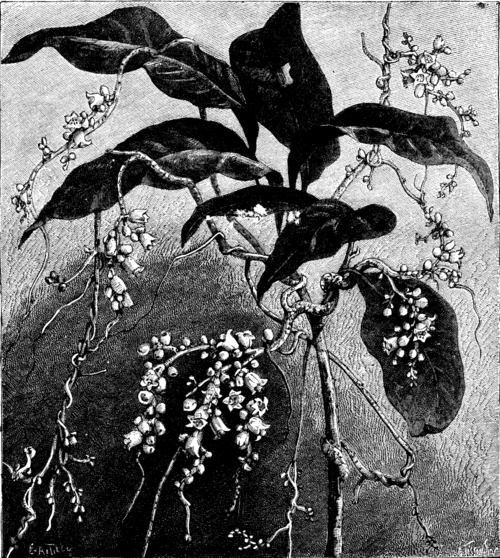
A NEW EXOTIC DODDER. (Cuscuta Reflexa.)
Continue to:


My Books

