


The Generation Of Steam, And The Thermodynamic Problems Involved. Part 3
Description
This section is from "Scientific American Supplement". Also available from Amazon: Scientific American Reference Book.
The Generation Of Steam, And The Thermodynamic Problems Involved. Part 3
If I am justified in taking this view, then I am justified in applying to my heat engine the general principles laid down in 1824 by Sadi Carnot, namely, that the proportion of work which can be obtained out of any substance working between two temperatures depends entirely and solely upon the difference between the temperatures at the beginning and end of the operation; that is to say, if T be the higher temperature at the beginning, and t the lower temperature at the end of the action, then the maximum possible work to be got out of the substance will be a function of (T-t). The greatest range of temperature possible or conceivable is from the absolute temperature of the substance at the commencement of the operation down to absolute zero of temperature, and the fraction of this which can be utilized is the ratio which the range of temperature through which the substance is working bears to the absolute temperature at the commencement of the action. If W = the greatest amount of effect to be expected, T and t the absolute temperatures, and H the total quantity of heat (expressed in foot pounds or in water evaporated, as the case may be) potential in the substance at the higher temperature, T, at the beginning of the operation, then Carnot's law is expressed by the equation:
| W = H ( | T - t | ) |
| T |
I will illustrate this important doctrine in the manner which Carnot himself suggested.
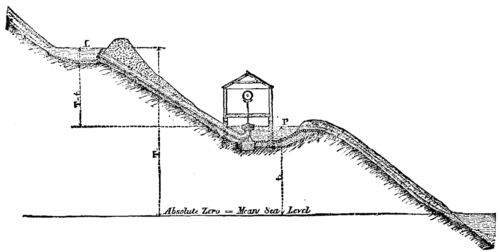
THE GENERATION OF STEAM. Fig 2.
Fig. 2 represents a hillside rising from the sea. Some distance up there is a lake, L, fed by streams coming down from a still higher level. Lower down on the slope is a millpond, P, the tail race from which falls into the sea. At the millpond is established a factory, the turbine driving which is supplied with water by a pipe descending from the lake, L. Datum is the mean sea level; the level of the lake is T, and of the millpond t. Q is the weight of water falling through the turbine per minute. The mean sea level is the lowest level to which the water can possibly fall; hence its greatest potential energy, that of its position in the lake, = QT = H. The water is working between the absolute levels, T and t; hence, according to Carnot, the maximum effect, W, to be expected is -
| W = H ( | T - t T | ) | |
| but H = QT ∴ | W = QT ( | T - t | ) |
| T | |||
| W = Q (T - t), | |||
that is to say, the greatest amount of work which can be expected is found by multiplying the weight of water into the clear fall, which is, of course, self-evident.
Now, how can the quantity of work to be got out of a given weight of water be increased without in any way improving the efficiency of the turbine? In two ways:
1. By collecting the water higher up the mountain, and by that means increasing T.
2. By placing the turbine lower down, nearer the sea, and by that means reducing t.
Now, the sea level corresponds to the absolute zero of temperature, and the heights T and t to the maximum and minimum temperatures between which the substance is working; therefore similarly, the way to increase the efficiency of a heat engine, such as a boiler, is to raise the temperature of the furnace to the utmost, and reduce the heat of the smoke to the lowest possible point. It should be noted, in addition, that it is immaterial what liquid there may be in the lake; whether water, oil, mercury, or what not, the law will equally apply, and so in a heat engine, the nature of the working substance, provided that it does not change its physical state during a cycle, does not affect the question of efficiency with which the heat being expended is so utilized. To make this matter clearer, and give it a practical bearing, I will give the symbols a numerical value, and for this purpose I will, for the sake of simplicity, suppose that the fuel used is pure carbon, such as coke or charcoal, the heat of combustion of which is 14,544 units, that the specific heat of air, and of the products of combustion at constant pressure, is 0.238, that only sufficient air is passed through the fire to supply the quantity of oxygen theoretically required for the combustion of the carbon, and that the temperature of the air is at 60° Fahrenheit = 520° absolute.
The symbol T represents the absolute temperature of the furnace, a value which is easily calculated in the following manner: 1 lb. of carbon requires 2-2/3 lb. of oxygen to convert it into carbonic acid, and this quantity is furnished by 12.2 lb. of air, the result being 13.2 lb. of gases, heated by 14,544 units of heat due to the energy of combustion; therefore:
| T = 520° + | 14,544 units | = 5,150° absolute. |
| 13.2 lb. × 0.238 |
The lower temperature, t, we may take as that of the feed water, say at 100° or 560° absolute, for by means of artificial draught and sufficiently extending the heating surface, the temperature of the smoke may be reduced to very nearly that of the feed water. Under such circumstances the proportion of heat which can be realized is
| = | 5,150° - 560° | = 0.891; |
| 5,150° |
that is to say, under the extremely favorable if not impracticable conditions assumed, there must be a loss of 11 per cent. Next, to give a numerical value to the potential energy, H, to be derived from a pound of carbon, calculating from absolute zero, the specific heat of carbon being 0.25, and absolute temperature of air 520°:
| Units. | ||
| 1 lb. of carbon × 0.25 × 520 | = | 130 |
| 12.2 of air × 0.238 × 520 | = | 1,485 |
| Heat of combustion | = | 14,544 |
| 16,159 | ||
| Deduct heat equivalent to work of displacing atmosphere by products of combustion raised from 60° to 100°, or from 149.8 cubic feet to 161.3 cubic feet, | 32 | |
| Total units of heat available | 16,127 | |
Equal to 16.69 lb. of water evaporated from and at 212°. Hence the greatest possible evaporation from and at 212° from a lb. of carbon -
| W = | 16,159 u. × 0.891 - 32 u. | = 14.87 lb. |
| 966 u. |
I will now take a definite case, and compare the potential energy of a certain kind of fuel with the results actually obtained. For this purpose the boiler of the eight-horse portable engine, which gained the first prize at the Cardiff show of the Royal Agricultural Society in 1872, will serve very well, because the trials, all the details of which are set forth very fully in vol. ix. of the Journal of the Society, were carried out with great care and skill by Sir Frederick Bramwell and the late Mr. Menelaus; indeed, the only fact left undetermined was the temperature of the furnace, an omission due to the want of a trustworthy pyrometer, a want which has not been satisfied to this day.2 The data necessary for our purpose are:
| Steam pressure 80 lb. temperature | 324° = 784° | absolute. |
| Mean temperature of smoke | 389° = 849° | " |
| Water evaporated per 1 lb of coal, from and at 212° | 11.83 lb. | |
| Temperature of the air | 60° = 520° | absolute. |
| Temperature of feed water | 209° = 669° | " |
| Heating surface | 220 square feet. | |
| Grate surface | 3.29 feet. | |
| Coal burnt per hour | 41 lb. |
Continue to:


My Books

