


Crank And Screw Shafts Of The Mercantile Marine. Part 2
Description
This section is from "Scientific American Supplement". Also available from Amazon: Scientific American Reference Book.
Crank And Screw Shafts Of The Mercantile Marine. Part 2
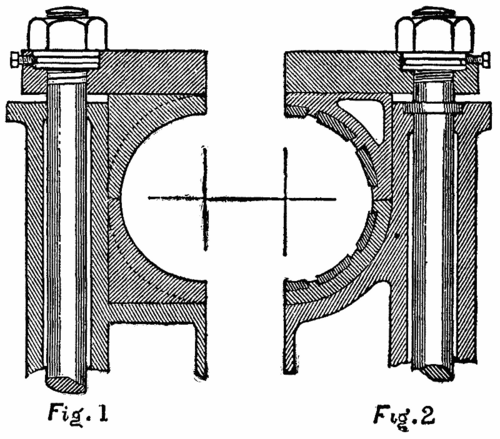
Figs. No. 1 and No. 2 show the design of the old and new main bearings, and, I think, require but little explanation. Most of you present will remember your feelings when, after a hot bearing, the brasses were found to be cracked at top and bottom, and the trouble you had afterward to keep these brasses in position. When a smoking hot bearing occurred, say in the heating of a crank pin, it had the effect of damaging the material of the shaft more or less, according to its original soundness, generally at the fillets in the angles of the cranks. For when the outer surface of the iron got hot, cold water, often of a low temperature, was suddenly poured on, and the hot iron, previously expanded, was suddenly contracted, setting up strains which in my opinion made a small tear transversely where the metal was solid; and where what is termed lamination flaws, due to construction, existed, these were extended in their natural direction, and by a repetition of this treatment these flaws became of such a serious character that the shafts had to be condemned, or actually gave way at sea. The introduction of the triple expansion engine, with the three cranks, gave better balance to the shaft, and the forces acting in the path of the crank pin, being better divided, caused more regular motion on the shaft, and so to the propeller. This is specially noticeable in screw steamers, and is taken advantage of by placing the cabins further aft, nearer the propeller, the stern having but little vibration; the dull and heavy surging sound, due to unequal motions of the shaft in the two-crank engines, is exchanged for a more regular sound of less extent, and the power formerly wasted in vibrating the stern is utilized in propelling the vessel. In spite of all these improvements I have mentioned, there remains the serious question of defects in the material, due to variety of quality and the extreme care that has to be exercised in all the stages during construction of crank or other shafts built of iron.
Many shafts have given out at sea and been condemned, through no other cause than original defects in their construction and material.
The process of welding and forging a crank shaft of large diameter now is to make it up of so many small pieces, the best shafts being made of what is termed scrap, representing thousands of small pieces of selected iron, such as cuttings of old iron boiler plates, cuttings off forgings, old bolts, horseshoes, angle iron, etc., all welded together, forged into billets, reheated, and rolled into bars. It is then cut into lengths, piled, and formed into slabs of suitable size for welding up into the shafts. No doubt this method is preferable to the old method of "fagoting," so called, as the iron bars were placed side by side, resembling a bundle of fagots of about 18 or 20 inches square.
The result was that while the outside bars would be welded, the inside would be improperly welded, or, the hammer being weak, the blow would be insufficient to secure the proper weld, and it was no uncommon thing for a shaft to break and expose the internal bars, showing them to be quite separate, or only partially united. This danger has been much lessened in late years by careful selection of the materials, improved methods of cleaning the scrap, better furnaces, the use of the most suitable fuels, and more powerful steam hammers. Still, with all this care, I think I may say there is not a shaft without flaws or defects, more or less, and when these flaws are situated in line of the greatest strains, and though you may not have a hot bearing, they often extend until the shaft becomes unseaworthy.
[Diagrams shown illustrated the various forms of flaws.] These flaws were not observable when the shafts were new, although carefully inspected. They gradually increased under strain, came to the outside, and were detected. Considerable loss fell upon the owners of these vessels, who were in no way to blame; nor could they recover any money from the makers of the shafts, who were alone to blame. I am pleased to state, and some of the members here present know, that considerable improvement has been effected in the use of better material than iron for crank shafts, by the introduction of a special mild steel, by Messrs. Vickers, Sons & Co., of Sheffield, and that instead of having to record the old familiar defects found in iron shafts, I can safely say no flaws have been observed, when new or during eight years running, and there are now twenty-two shafts of this mild steel in the company's service.
I may here state that steel was used for crank shafts in this service in 1863, as then manufactured in Prussia by Messrs. Krupp, and generally known as Krupp's steel, the tensile strength of which was about 40 tons per square inch, and though free from flaws, it was unable to stand the fatigue, and broke, giving little warning. It was of too brittle a nature, more resembling chisel steel. It was broken again under a falling weight of 10 cwt. with a 10 ft. drop = 12½ tons.
The mild steel now used was first tried in 1880. It possessed tensile strength of 24 to 25 tons per square inch. It was then considered advisable not to exceed this, and err rather on the safe side. This shaft has been in use eight years, and no sign of any flaw has been observed. Since then the tensile strength of mild steel has gradually been increased by Messrs. Vickers, the steel still retaining the elasticity and toughness to endure fatigue. This has only been arrived at by improvements in the manufacture and more powerful and better adapted hammers to forge it down from the large ingots to the size required. The amount of work they are now able to subject the steel to renders it more fit to sustain the fatigue such as that to be endured by a crank shaft. These ingots of steel can be cast up to 100 tons weight, and require powerful machines to deal with them. For shafts say of 20 inches diameter, the diameter of the ingot would be about 52 inches. This allows sufficient work to be put on the couplings, as well as the shaft.
Continue to:


My Books

