


The Codling Moth. Carpocapsa Pomonella (Linn.)
Description
This section is from "Scientific American Supplement". Also available from Amazon: Scientific American Reference Book.
The Codling Moth. Carpocapsa Pomonella (Linn.)
This well known insect has a world-wide reputation, and is now found wherever apples are raised.
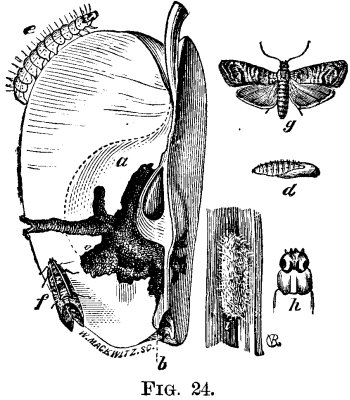
The moths are on the wing about the time the young apples are beginning to set, and the female lays a single egg in the blossom end of each apple. The fore wings of the moths when expanded, Fig. 24, g (f, with the wings closed), measure about half an inch across, and are marked with alternate wavy, transverse streaks of ashy gray and brown, and have on the inner hind angle a large tawny brown, horseshoe shaped spot, streaked with light bronze or copper color. The hind wings and abdomen are light brown with a luster of satin.
Each female lays about fifty eggs, which are minute, flattened, scale-like bodies of a yellowish color. In about a week the eggs hatch and the tiny caterpillar begins to eat through the apple to the core, Fig. 24, a, pushing its castings out through the hole where it entered, Fig. 24, b. Oftentimes these are in sight on the outside in a dark colored mass, thus making wormy apples plainly seen at quite a distance.
The caterpillar is about two-fifths of an inch in length, of a glossy, pale yellowish white color, with a light brown head. The skin is transparent and the internal organs give to it a reddish tinge.
When mature the caterpillars, Fig. 24, e, top of head and second segment, h, emerge from the apples and seek some sheltered place, such as crevices of bark, or corners of the boxes or barrels in which the fruit is stored, where they spin a tough whitish cocoon, Fig. 24, i, in which they remain unchanged all winter, and transform to pupae, Fig. 24, d, the next spring, the perfect moths emerging in time to lay their eggs in the new crop of apples.
One good remedy is to gather all the fallen apples, and feed them to hogs; another is to let swine and sheep run in the orchard, and eat the infested fruit.
It has been recommended to place bands of cloth or hay around the trunks of the trees for the caterpillars to spin their cocoons beneath, and to remove them at the proper time, and put them in scalding water to destroy the worms.
By far the most successful method as yet adopted is to shower the apple trees with Paris green in water, one pound to one hundred and fifty gallons of water, when the apples are about the size of peas, and again in about a week.
Continue to:


My Books

