


The Gartered Plume Moth. Oxyptilus Periscelidactylus (Fitch.)
Description
This section is from "Scientific American Supplement". Also available from Amazon: Scientific American Reference Book.
The Gartered Plume Moth. Oxyptilus Periscelidactylus (Fitch.)
The caterpillars of this species draw together the young grape leaves, Fig. 26, a, in the spring, with fine silken threads, and feed on the inside, thus doing much damage in proportion to their size. These caterpillars, Fig. 26, a, and e, a segment greatly enlarged, are full grown in about two weeks, when they are about one-fourth of an inch long, pale green with whitish hairs arising from a transverse row of warts on each segment.
Early in June they transform to pupae, Fig. 26, b, which are pale green at first and change to dark brown. The surface is rough and the head is cut off obliquely, while on the upper side near the middle are two sharp pointed horns, Fig. 26, c. They remain in this stage from a week to ten days, when the moths emerge.
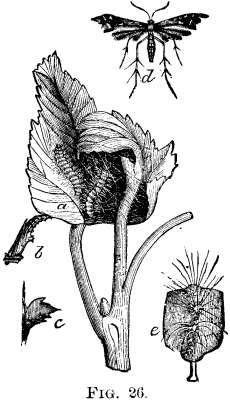
The moths, Fig. 26, d, belong to the family commonly known as plume moths or feather wings (Pterophoridae), from having their wings divided into feather-like lobes. When the wings are expanded they measure about seven-tenths of an inch across. They are yellowish brown with a metallic luster, and have several dull whitish streaks and spots. The fore wings are split down the middle about half way to their base, the posterior half having a notch in the outer margin. The body is somewhat darker than the wings.
It is not known positively in what stage the winter is passed, but it is supposed to be the perfect, or imago stage. The unnatural grouping and spinning of the leaves together leads to their detection, and they can be easily destroyed by hand picking and then crushing or burning them.
Continue to:


My Books

