


The Subterranean Temples Of India
Description
This section is from "Scientific American Supplement". Also available from Amazon: Scientific American Reference Book.
The Subterranean Temples Of India
During the last fifteen years Bombay has undergone a complete transformation, and the English are now making of it one of the prettiest cities that it is possible to see. The environs likewise have been improved, and thanks to the railways and bungalows (inns), many excursions may now be easily made, and tourists can thus visit the wonders of India, such as the subterranean temples of Ajunta, Elephanta, Nassik, etc., without the difficulties of heretofore.
The excavations of Elephanta are very near Bombay, and the trip in the bay by boat to the island where they are located is a delightful one. The deplorable state in which these temples now exist, with their broken columns and statues, detracts much from their interest. The temples of Ajunta, perhaps the most interesting of all, are easier of access, and are situated 250 miles from Bombay and far from the railway station at Pachora, where it is necessary to leave the cars. Here an ox cart has to be obtained, and thirty miles have to be traveled over roads that are almost impassable. It takes the oxen fifteen hours to reach the bungalow of Furdapore, the last village before the temples, and so it is necessary to purchase provisions. In these wild and most picturesque places, the Hindoos cannot give you a dinner, even of the most primitive character. It was formerly thought that the subterranean temples of India were of an extraordinary antiquity.
The Hindoos still say that the gods constructed these works, but of the national history of the country they are entirely ignorant, and they do not, so to speak, know how to estimate the value of a century. The researches made by Mr. Jas. Prinsep between 1830 and 1840 have enlightened the scientific world as to the antiquity of the monuments of India. He succeeded in deciphering the Buddhist inscriptions that exist in all the north of India beyond the Indus as far as to the banks of the Bengal. These discoveries opened the way to the work done by Mr. Turnour on the Buddhist literature of Ceylon, and it was thus that was determined the date of the birth of Sakya Muni, the founder of Buddhism. He was born 625 B.C. and his death occurred eighty years later, in 543. It is also certain that Buddhism did not become a true religion until 300 years after these events, under the reign of Aoska. The first subterranean temples cannot therefore be of a greater antiquity. Researches that have been made more recently have in all cases confirmed these different results, and we can now no longer doubt that these temples have been excavated within a period of fourteen centuries.
Dasaratha, the grandson of Aoska, first excavated the temples known under the name of Milkmaid, in Behar (Bengal), 200 B.C., and the finishing of the last monument of Ellora, dedicated by Indradyumna to Indra Subha, occurred during the twelfth century of our era.

Fig. 1. - FACADE OF THE TEMPLE OF PANDU LENA.
We shall speak first of the temples of Pandu Lena, situated in the vicinity of Nassik, near Bombay. These are less frequented by travelers, and that is why I desired to make a sketch of them (Fig. 1). The church of Pandu Lena is very ancient. Inscriptions have been found upon its front, and in the interior on one of the pillars, that teach us that it was excavated by an inhabitant of Nassik, under the reign of King Krishna, in honor of King Badrakaraka, the fifth of the dynasty of Sunga, who mounted the throne 129 B.C.
The front of this church, all carved in the rock, is especially remarkable by the perfection of the ornaments. In these it is to be seen that the artist has endeavored to imitate in rock a structure made of wood. This is the case in nearly all the subterranean temples, and it is presumable that the architects of the time did their composing after the reminiscences of the antique wooden monuments that still existed in India at their epoch, but which for a long time have been forever destroyed. The large bay placed over the small front door gives a mysterious light in the nave of the church, and sends the rays directly upon the main altar or dagoba, leaving the lateral columns and porticoes in a semi-obscurity well calculated to inspire meditation and prayer.
The temples and monasteries of Ajunta, too, are of the highest interest. They consist of 27 grottoes, of which four only are churches or chaityas. The 23 other excavations compose the monasteries or viharas. Begun 100 B.C., they have remained since the tenth century of our era as we now see them. The subterranean monasteries are majestic in appearance. Sustained by superb columns with curiously sculptured capitals, they are ornamented with admirable frescoes which make us live over again the ancient Hindoo life. The paintings are unfortunately in a sad state, yet for the tourist they are an inexhaustible source of interesting observations.
The excavations, which have been made one after another in the wall of volcanic rock of the mountain, form, like the latter, a sort of semicircle. But the churches and monasteries have fronts whose richness of ornamentation is unequaled. The profusion of the sculptures and friezes, ornamented with the most artistic taste, strikes you with so much the more admiration in that in these places they offer a perfect and varied ensemble of the true type of the Buddhist religion during this long period of centuries. The picturesque landscape that surrounds these astonishing sculptures adds to the beauty of these various pictures.
The temples of Ellora are no less remarkable, but they do not offer the same artistic ensemble. The excavations may be divided into three series: ten of them belong to the religion of Buddha, fourteen to that of Brahma, and six to the Dravidian sect, which resembles that of Jaius, of which we still have numerous specimens in the Indies. Excavated in the same amygdaloid rock, the temples and monasteries differ in aspect from those of Ajunta, on account of the form of the mountain. Ajunta is a nearly vertical wall. At Ellora, the rock has a gentle slope, so that, in order to have the desired height for excavating the immense halls of the viharas or the naves of the chaityas, it became necessary to carve out a sort of forecourt in front of each excavation.
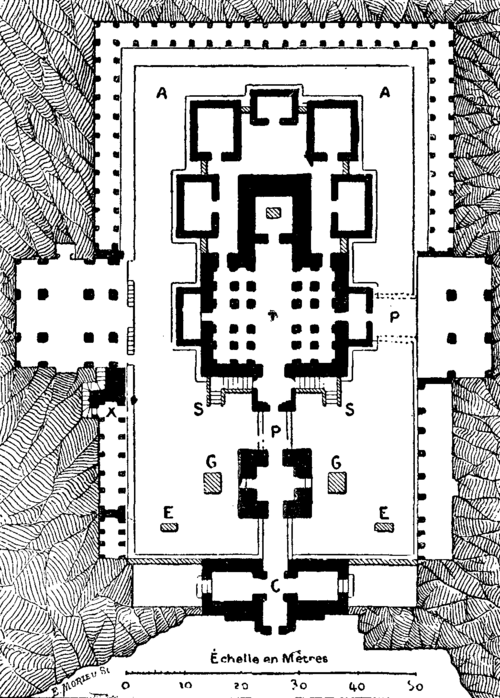
Fig. 2. - PLAN OF THE TEMPLES OF KYLAS.
Some of the churches thus have their entrance ornamented with porticoes, and the immense monasteries (which are sometimes three stories high) with lateral entrances and facades. The mountain has also been excavated in other places, so as to form a relatively narrow entrance, which gives access to the internal court of one of these monasteries. It thus becomes nearly invisible to whoever passes along the road formed on the sloping side of the mountain. The greatest curiosity among the monuments of Ellora is the group of temples known by the name of Kylas (Fig. 2). The monks have excavated the rocky slope on three faces so as to isolate completely, in the center, an immense block, out of which they have carved an admirable temple (see T in the plan, Fig. 2), with its annexed chapels. These temples are thus roofless and are sculptured externally in the form of pagodas. Literally covered with sculptures composed with infinite art, they form a very unique collection. These temples seem to rest upon a fantastic base in which are carved in alto rilievo all the gods of Hindoo mythology, along with symbolic monsters and rows of elephants.
These are so many caryatides of strange and mysterious aspect, certainly designed to strike the imagination of the ancient Indian population (Fig. 3).

Fig. 3. - SUBTERRANEAN TEMPLE AT ELLORA.
Two flights of steps at S and S (Fig. 2) near the main entrance of Kylas lead to the top of this unique base and to the floor of the temples.
The interior of the central pagoda, ornamented with sixteen magnificent columns, formerly covered, like the walls, with paintings, and the central sanctuary that contains the great idol, are composed with a perfect understanding of architectural proportions.
Exit from this temple is effected through two doors at the sides. These open upon a platform where there are five pagodas of smaller size that equal the central temple in the beauty of their sculptures and the elegance of their proportions.
Around these temples great excavations have been made in the sides of the mountain. At A (Fig. 2), on a level with the ground, is seen a great cloister ornamented with a series of bass reliefs representing the principal gods of the Hindoo paradise. The side walls contain large, two-storied halls ornamented with superb sculptures of various divinities. Columns of squat proportions support the ceilings. A small stairway, X (Fig. 2), leads to one of these halls. Communication was formerly had with its counterpart by a stone bridge which is now broken. There still exist two (P) which lead from the floor of the central temple to the first story of the detached pavilion or mantapa, D, and to that of the entrance pavilion or gopura, C. At G we still see two sorts of obelisks ornamented with arabesques and designed for holding the fires during religious fetes. At E are seen two colossal elephants carved out of the rock. These structures, made upon a general plan of remarkable character, are truly without an equal in the entire world.
We may thus see how much art feeling the architects of these remote epochs possessed, and express our wonder at the extreme taste that presided over all these marvelous subterranean structures. - A. Tissandier, in La Nature.
[Nature.]
Continue to:


My Books

