


Demolition Of Rocks Under Water Without Explosives-Lobnitz System
Description
This section is from "Scientific American Supplement". Also available from Amazon: Scientific American Reference Book.
Demolition Of Rocks Under Water Without Explosives-Lobnitz System
By EDWIN S. CRAWLEY.
The methods of demolishing rocks by the use of explosives are always attended by a certain amount of danger, while at the same time there is always more or less uncertainty in regard to the final result of the operation. Especially is this the case when the work must be carried on without interrupting navigation and in the vicinity of constructions that may receive injury from the explosions.
Such were the conditions imposed in enlarging the Suez Canal in certain parts where the ordinary dredges could not be used.
Mr. Henry Lobnitz, engineer at Renfrew, has contrived a new method of procedure, designed for the purpose of enlarging and deepening the canal in those parts between the Bitter Lakes and Suez, where it runs over a rocky bed. It was necessary to execute the work without interrupting or obstructing traffic on the canal.
The principle of the system consists in producing a shattering of the rock by the action of a heavy mass let fall from a convenient height, and acting like a projectile of artillery upon the wall of a fortress.
From experiments made in the quarry of Craigmiller, near Edinburgh, with a weight of two tons shod with a steel point, it was found that with a fall of about 5.5 meters (18.04 ft.) there was broken up on an average more than 0.113 cubic meter (0.148 cubic yard) of hard rock per blow. The first blow, delivered 90 centimeters (2 ft. 11½ in.) from the wall face, produced an almost imperceptible rent, a second or a third blow applied at the same place extended this opening often to a length of 1.50 meters (4 ft. 11 in.) and to a depth of from 90 to 120 centimeters (2 ft. 11 in. to 3 ft. 11 in.) The next blow opened the fissure and detached the block of rock.
The application of the same system under water upon an unknown surface would obviously modify the conditions of the experiment. Nevertheless, the results obtained with the "Derocheuse," the first dredging machine constructed upon this principle, have realized the hopes of the inventor.
This dredging machine was launched on the Clyde and reached Port Said in twenty days. It measures 55 meters (180 ft. 5 in.) in length, 12.20 meters (40 ft. 1 in.) in breadth, and 3.65 meters (12 ft.) in depth. Its mean draught of water is 2.75 meters (9 ft. 2½ in.) It is divided into eighteen watertight compartments. Five steel-pointed battering rams, each of four tons weight, are arranged in line upon each side of the chain of buckets of the dredging machine. See Figs. 1 and 2. The battering rams, suspended by chains, are raised by hydraulic power to a height varying from 1.50 to 6 meters (4 ft. 11 in. to 19 ft. 8 in.), and are then let fall upon the rock. The mechanism of the battering rams is carried by a metallic cage which can be moved forward or backward by the aid of steam as the needs of the work require. A series of five battering rams gives from 200 to 300 blows per hour.
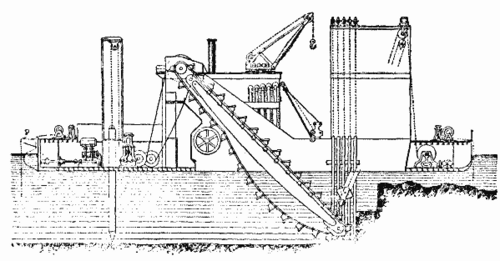
FIG. 1. - LONGITUDINAL SECTION.
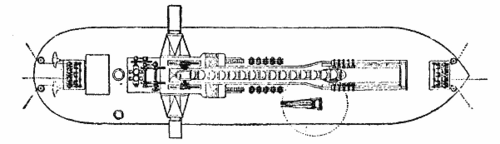
FIG. 2. - PLAN
A dredging machine combined with the apparatus just described, raises the fragments of rock as they are detached from the bottom. A guide wheel is provided, which supports the chain carrying the buckets, and thus diminishes the stress upon the axles and bearings. With this guide wheel or auxiliary drum there is no difficulty in dredging to a depth of 12 meters (39 ft. 4 in.), while without this accessory it is difficult to attain a depth of 9 meters (29 ft. 6 in.)
A compound engine, with four cylinders of 200 indicated horse power, drives, by means of friction gear, the chain, which carries the buckets. If the buckets happen to strike against the rock, the friction gear yields until the excess of resistance has disappeared.
Fig. 3 indicates the manner in which the dredge is operated during the work. It turns alternately about two spuds which are thrust successively into the bottom and about which the dredge describes a series of arcs in a zigzag fashion. These spuds are worked by hydraulic power.
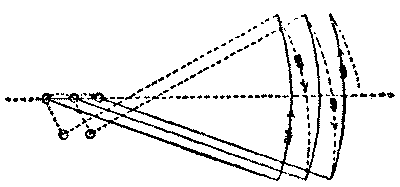
FIG. 3. - DREDGE MOVEMENT.
A three ton hand crane is placed upon the bridge for use in making repairs to the chain which carries the buckets. A six ton steam crane is placed upon the top of the cage which supports the hydraulic apparatus for raising the battering rams, thus permitting them to be easily lifted and replaced.
The dredging machine is also furnished with two screws driven by an engine of 300 indicated horse power, as well as with two independent boilers. Two independent series of pumps, with separate connections, feed the hydraulic lifting apparatus, thus permitting repairs to be made when necessary, without interrupting the work. A special machine with three cylinders drives the pumps of the condenser. An accumulator regulates the hydraulic pressure and serves to raise or lower the spuds.
At the end of the Suez Canal next to the Red Sea, the bottom consists of various conglomerates containing gypsum, sandstone and sometimes shells. It was upon a bed of this nature that the machine was first put to work. The mean depth of water, originally 8.25 meters (26 ft. 3 in.), was for a long time sufficient for the traffic of the canal; but as the variations in level of the Red Sea are from 1.8 to 3 meters (5 ft. 11 in. to 9 ft. 10 in.), the depth at the moment of low water is scarcely adequate for the constantly increasing draught of water of the steamers. Attempts were made to attack the rocky surface of the bottom with powerful dredges, but this method was expensive because it necessitated constant repairs to the dredges.
These last, although of good construction, seldom raised more than 153 cubic meters (200 cubic yards) in from eight to fifteen days. Their daily advance was often only from sixty to ninety centimeters (about 2 to 3 ft.), while with the "Derocheuse" it was possible to advance ten times as rapidly in dredging to the same depth. The bottom upon which the machine commenced its work was clean and of a true rocky nature. It was soon perceived that this conglomerate, rich in gypsum, possessed too great elasticity for the pointed battering rams to have their proper effect upon it. Each blow made a hole of from fifteen to sixty centimeters (6 in. to 2. ft.) in depth. A second blow, given even very near to the first, formed a similar hole, leaving the bed of the rock to all appearances intact between the two holes. This result, due entirely to the special nature of the rock, led to the fear that the action of the battering rams would be without effect. After some experimentation it was found that the best results were obtained by arranging the battering rams very near to the chain of buckets and by working the dredge and battering rams simultaneously.
The advance at each oscillation was about 90 centimeters (about 3 ft.)
The results obtained were as follows: At first the quantity extracted varied much from day to day; but at the end of some weeks, on account of the greater experience of the crew, more regularity was obtained. The nature of the conglomerate was essentially variable, sometimes hard and tenacious, like malleable iron, then suddenly changing into friable masses surrounded by portions more elastic and richer in gypsum.
During the last five weeks at Port Tewfik, the expense, including the repairs, was 8,850 francs ($1,770.00) for 1,600 cubic meters (2,093 cubic yards) extracted. This would make the cost 5.52 francs per cubic meter, or $0.84 per cubic yard, not including the insurance, the interest and the depreciation of the plant.
After some improvements in details, suggested by practice, the machine was put in operation at Chalouf upon a hard rock, from 1.50 to 3 meters (4 ft. 11 in. to 9 ft. 10 in.) thick. The battering rams were given a fall of 1.80 meters (5 ft. 11 in.). To break the rock into fragments small enough not to be rejected by the buckets of the dredge, the operations of dredging and of disintegration were carried on separately, permitting the battering rams to work at a greater distance from the wall face. The time consumed in thus pulverizing the rock by repeated blows was naturally found to be increased. It was found more convenient to use only a single row of battering rams. The production was from about seven to eleven cubic meters (9.2 to 14.4 cubic yards) per hour. Toward the close of September, after it had been demonstrated that the "Derocheuse" was capable of accomplishing with celerity and economy the result for which it was designed, it was purchased by the Suez Canal Company.
During the month of September, an experiment, the details of which were carefully noted, extending over a period of sixteen days, gave the following results:
| Crew (33 men), 140 hours. | 2,012.50 francs | $402.50 |
| Coal, @ 87.50 francs ($7.50) per ton | 787.50 francs | 157.50 |
| Oil and supplies | 220.00 francs | 44.00 |
| Fresh water, 16 days | 210.00 francs | 42.00 |
| Sundries | 42.50 francs | 8.50 |
| - - - - - | - - - | |
| Total expense for removing 764 cubic meters (999.2 cubic yards), | 3,272.50 francs | $654.50 |
Average, 4.28 francs per cubic meter ($0.65 per cubic yard).
This result cannot be taken as a universal basis, because after a year's use there are numerous repairs to make to the plant, which would increase the average net cost. This, besides, does not include the cost of removal of the dredged material, nor the depreciation, the interest and the insurance.
It should be added on the other hand, however, that the warm season was far from being favorable to the energy and perseverance necessary to carry on successfully experiments of this kind. The temperature, even at midnight, was often 38°C. (100.4° F.). Still further, the work was constantly interrupted by the passage of ships through the canal. On an average not more than forty minutes' work to the hour was obtained. Notwithstanding this, there were extracted at Chalouf, on an average, 38.225 cubic meters (50 cubic yards) per day without interrupting navigation. At Port Tewfik, where there was much less inconvenience from the passage of ships, the work was carried on from eight to eleven hours per day and the quantity extracted in this time was generally more than 76 cubic meters (99.4 cubic yards).
In most cases the system could be simplified. The engine which works the dredge could, when not thus employed, be used to drive the pumps. The propelling engine could also be used for the same purpose.
The results obtained at Suez indicate the appreciable advantages arising from the application of this system to the works of ports, rivers and canals, and ever, to the work of cutting in the construction of roads and railroads.
[1]Read before the Engineer's Club, Philadelphia. Translated from Nouvelles Anodes de la Construction, March, 1890.
Continue to:


My Books

